
Ancestral healing meditation is a structured spiritual practice designed to connect you with your lineage and release inherited emotional patterns that shape your present life. This guide covers everything you need to start, from physical preparation and step-by-step technique to overcoming emotional blocks and building a lasting practice. You will work with tools like guided visualization, somatic awareness, affirmations, and grounding rituals drawn from traditions including Andean ceremony and Yi spiritual ecology. Healing lineage meditation frees inherited emotional blocks, enabling peace and release from generational trauma. The goal is not just personal relief. It is connection, clarity, and the kind of deep healing that flows through generations.
What do you need to prepare before an ancestral healing meditation?
Preparation determines the quality of your meditation experience. A rushed or cluttered environment signals to your nervous system that it is not safe to open up. Thoughtful setup removes that barrier before you even close your eyes.
Choosing your space and props
Your physical environment carries real weight in this practice. Ancestral healing practices work best when the body feels genuinely supported and the senses are calm. Select a quiet room where you will not be interrupted for at least 20–30 minutes.
Consider gathering a few simple objects to enrich the session:
- Candles or soft lighting to signal a shift from ordinary time into reflective space
- Incense or essential oils such as frankincense, cedar, or sage to engage the sense of smell
- A blanket or cushion to keep the body warm and physically grounded
- A photograph or object connected to a family member or ancestor, if available
- A journal placed nearby to capture insights immediately after the session
Creating a sensory environment with objects like candles and blankets enriches the meditation experience. This is not decoration. Sensory cues help the brain shift into a receptive, inward state faster than breath alone.
Setting your intention

Mental readiness matters as much as physical setup. Before you begin, take a moment to name what you are bringing to the practice. You might write one sentence: “I am here to release the fear I inherited from my family around financial security.” Specificity focuses the session and gives your subconscious a clear direction.
Pro Tip: Begin every session with two minutes of grounding. Press your feet flat on the floor, feel the weight of your body in the chair or cushion, and take three slow breaths. Feeling physically supported by your seat or the earth enhances your sense of safety and deepens the connection to ancestral support.
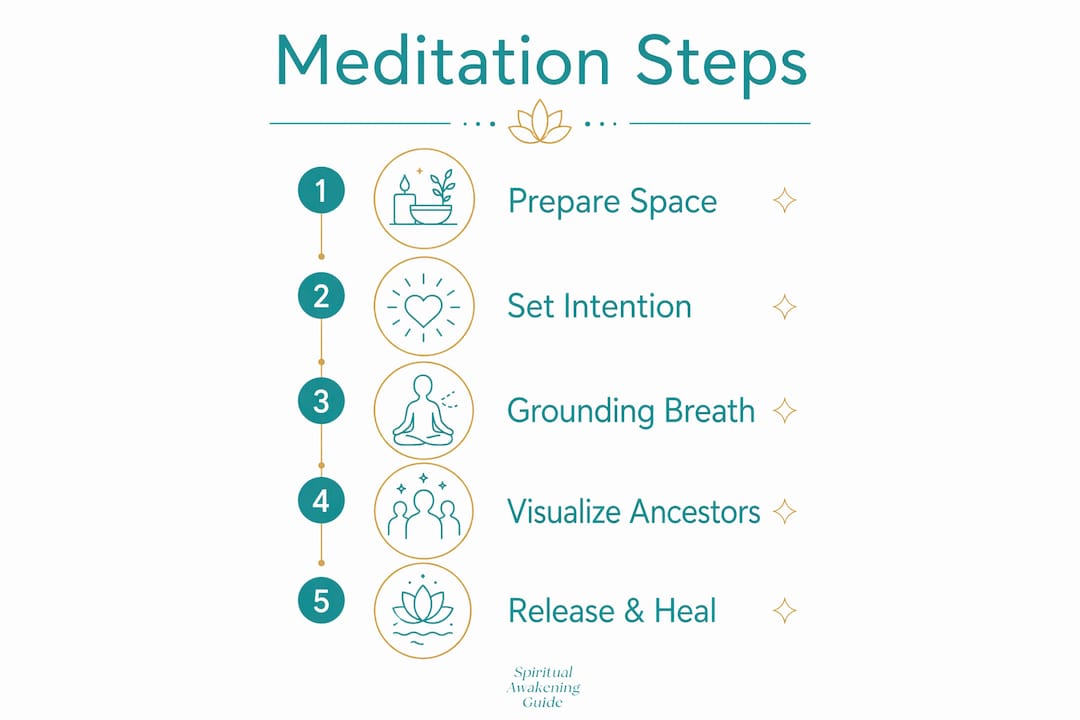
How to perform an ancestral healing meditation step by step
This framework draws from both modern guided meditation practice and cross-cultural ritual traditions. Follow each step in order. Consistency in sequence builds a reliable internal pathway over time.
Ground your body. Sit or lie in a comfortable position. Feel the contact between your body and the surface beneath you. Take five slow, deep breaths, extending the exhale slightly longer than the inhale.
Set your intention aloud. Speak your intention in one sentence, either silently or out loud. Naming it activates focused attention and signals the nervous system to prepare for meaningful inner work.
Visualize your lineage. Imagine a line of ancestors standing or seated behind you, extending back through generations. You do not need to know their names or faces. A felt sense of presence is enough. If direct ancestors feel uncomfortable to connect with, focusing on meaningful historical figures or spiritual teachers can provide equally valuable guidance.
Receive ancestral wisdom. Sit quietly for 3–5 minutes and notice any images, words, feelings, or physical sensations that arise. Do not analyze them during the session. Simply receive.
Repeat an affirmation three times. Traditional Andean healing rituals repeat core procedures three times at fixed intervals to achieve potent effects. Use a phrase like: “I release what was never mine to carry. I receive the strength of those who came before me.” Repeat it three times with full attention.
Express gratitude. Silently thank the ancestors or figures you connected with. Gratitude closes the energetic loop and signals completion to the nervous system.
Return and ground. Wiggle your fingers and toes, take three grounding breaths, and open your eyes slowly. Drink water. Write in your journal before doing anything else.
Pro Tip: Set a gentle timer for your session so you are not watching the clock. Even 15 minutes practiced consistently produces more benefit than a single 90-minute session done once a month.
Comparing meditation session lengths and formats
| Format | Duration | Best For |
|---|---|---|
| Brief daily acknowledgment | 5–10 minutes | Building a consistent habit and nervous system regulation |
| Guided audio session | 20–30 minutes | Beginners or those needing structured support |
| Silent self-guided session | 30–45 minutes | Experienced practitioners deepening their practice |
| Group or community session | 60–90 minutes | Processing collective or family trauma with shared support |
What common challenges arise and how do you overcome them?
Every practitioner encounters friction. Knowing what to expect prevents discouragement and keeps the practice moving forward.
The most common challenges include:
- Emotional overwhelm. Ancestral healing meditation can surface grief, anger, or sadness that has been stored for years. This is not a sign that something is wrong. It is a sign the practice is working.
- Mental distraction. The mind will wander, especially in early sessions. Return attention to the breath without judgment. Distraction is not failure.
- Skepticism or disconnection. Some practitioners feel nothing in early sessions. This is normal. Ancestral healing practices follow a six-stage framework of rooting, nourishing, growing, flourishing, giving back, and becoming. The early stages are quiet and internal.
- Difficulty connecting with specific ancestors. If a direct family member carries painful associations, shift your focus. Connecting with spiritual teachers or impactful historical figures is a recognized and effective alternative.
Ancestral healing is not a solo endeavor. Healing in community is foundational to this practice. Private suffering, processed entirely alone, limits the depth of transformation available. Consider joining a grief circle, a lineage healing group, or a trusted spiritual community to expand what is possible.
Holistic grief healing practices offer structured frameworks for processing ancestral loss alongside others, which research consistently shows produces better outcomes than solitary work.
How do you sustain and deepen your practice over time?
A single session plants a seed. A regular practice grows a root system. Sustaining spiritual lineage meditation requires structure, reflection, and gradual expansion.
Build a consistent schedule. Choose a specific time of day and protect it. Morning sessions before the demands of the day begin tend to produce the clearest inner access. Regular short ancestral acknowledgments or even calling ancestors’ names can initiate deep nervous system release over time. Consistency matters more than duration.
Journal after every session. Write down images, phrases, emotions, or physical sensations within five minutes of finishing. Patterns emerge across sessions that would otherwise be invisible. Over weeks, your journal becomes a map of your lineage’s emotional terrain.
Integrate ritual and ceremony. Ritual transforms routine into meaning. Lighting a candle before each session, placing a photo of an ancestor on a small altar, or observing culturally specific ancestral remembrance dates all deepen the practice. Sacred rituals serve as social governance tools that transform individual trauma into community healing, giving cosmic meaning to suffering and building hope.
Explore cross-cultural traditions. Ancestral veneration appears in Yoruba, Shinto, Andean, Celtic, and Chinese traditions, among many others. Studying one tradition in depth adds texture and authority to your personal practice. You do not need to adopt another culture’s rituals wholesale. Learning how different lineages approach ancestor connection expands your own vocabulary for the work.
Comparing supportive practices for long-term growth
| Practice | Primary Benefit | Frequency |
|---|---|---|
| Journaling | Tracks patterns and insights across sessions | After every session |
| Altar or sacred space | Maintains a physical anchor for the practice | Ongoing |
| Community healing circles | Expands personal healing into collective wellness | Monthly or as available |
| Cross-cultural study | Deepens understanding of ancestral healing traditions | Weekly reading |
| Nature-based rituals | Grounds the body and connects to ancestral land | Weekly or seasonal |
Community involvement in ancestral healing expands personal healing into collective wellness and connection. This is not optional enrichment. It is a core mechanism of how this practice produces lasting change.
Key takeaways
Ancestral healing meditation works because it combines structured visualization, somatic grounding, and ritual repetition to release inherited emotional patterns and restore connection to lineage wisdom.
| Point | Details |
|---|---|
| Prepare your environment | Use candles, cushions, and a clear intention to signal safety to your nervous system. |
| Follow a seven-step framework | Move from grounding through visualization, affirmation, gratitude, and journaling in sequence. |
| Expect emotional friction | Overwhelm and disconnection are normal early signs that the practice is engaging deep material. |
| Use community support | Group healing sessions produce deeper transformation than solitary practice alone. |
| Build consistency over intensity | Short daily sessions outperform occasional long ones for nervous system regulation and lasting change. |
What i have learned from years of ancestral healing work
Most people come to this practice expecting a mystical experience. What they actually encounter is something quieter and more demanding. The first few sessions often feel like sitting in an empty room, waiting for someone who may not show up. That discomfort is the practice.
What I have found, both personally and through observing others, is that the real shift happens not during the meditation but in the days after. A conversation with a family member lands differently. A pattern you have repeated for years suddenly becomes visible. That is the work doing its job.
The part most guides skip is the body. Ancestral trauma lives in the nervous system, not just in memory or story. Spiritual health is integral to ancestral healing, not a supplement to physical or psychological work. When you feel your feet on the floor and your back against the chair during a session, you are not just getting comfortable. You are creating the physiological conditions for release.
My honest recommendation: do not wait until you feel ready. Start with five minutes, a candle, and one honest intention. The practice builds itself from there.
— Sean
Deepen your practice with Spiritualmethod
Ancestral healing meditation opens a door. What you find on the other side often calls for a broader set of tools and practices to fully integrate.
Spiritualmethod offers practical, structured guides for every stage of the inner healing process. If you are ready to expand beyond meditation into ceremony and ritual, the guide on sacred rituals for healing explores how intentional ritual practice heals both mind and soul at a structural level. For those drawn to working with the body and spirit together, the plant medicine healing ritual guide offers a complementary framework rooted in traditional practice. Spiritualmethod’s library is built for people who take their inner work seriously and want methods that actually hold up over time.
FAQ
What is ancestral healing meditation?
Ancestral healing meditation is a guided spiritual practice that uses visualization, breath, and affirmation to connect with lineage figures and release inherited emotional patterns. The goal is to promote peace, clarity, and generational healing.
How long does it take to feel results?
Most practitioners notice subtle shifts in awareness or emotional response within two to four weeks of consistent daily practice. Deeper transformation typically emerges over months, not sessions.
What if i do not know my ancestors?
Connecting with spiritual teachers or meaningful historical figures is a recognized and effective alternative when direct ancestral connection is unavailable or uncomfortable.
Can ancestral healing meditation help with trauma?
Yes. Healing lineage meditation releases inherited emotional blocks and promotes peace by addressing patterns stored in the nervous system, not just conscious memory. Working with a therapist alongside this practice is advisable for severe trauma.
How often should i practice ancestral healing meditation?
Daily short sessions of 10–15 minutes produce more consistent nervous system regulation than infrequent longer sessions. Regular ancestral acknowledgments over time initiate measurable shifts in emotional patterns and overall well-being.