
Spiritual awakening practices are the small, repeatable activities that help you notice your inner life more clearly and respond to it with care. The most dependable ones are grounding, reflective journaling, mindfulness, compassion and gratitude exercises, time in nature, and intention-setting. Each works best as a short, consistent routine, not a dramatic one-time event. This guide explains what each practice involves, how to combine them across a week, what the research does and does not show, and when to slow down and seek professional support.
TL;DR
- Start with three anchors: a brief grounding exercise, a few lines of reflective journaling, and a short mindfulness or compassion sitting. Ten to twenty minutes a day is enough to begin.
- Consistency matters more than intensity. A routine you can keep during a difficult week will do more than an ambitious one you abandon.
- Research supports mindfulness-based approaches for reducing distress, with moderate effects. It does not show that any practice guarantees a particular spiritual outcome.
- Stillness can bring up difficult emotions. If you have a history of trauma or feel overwhelmed, go slowly and involve a licensed mental health professional.
- Pair spiritual practice with emotional processing. Using spirituality to avoid a problem tends to make that problem harder to resolve.
Table of Contents
- What a spiritual awakening practice actually is
- Six practices to build a routine around
- A simple weekly routine
- When awakening feels hard
- Our perspective
- A structured option if you prefer a guide
- FAQ
- Sources
What a spiritual awakening practice actually is
People use the word “awakening” in many ways. For some it is a gradual shift in how they see their purpose and relationships. For others it follows a loss, an illness or a period of questioning. We cover the different meanings in our piece on what spiritual awakening means for you, and the practical point is the same in each case: awakening is not something you can force, but you can build conditions in which awareness deepens.
That is what a practice does. It is a structured, repeatable activity done on purpose, with attention, in a consistent place and at a consistent time. The top results for this topic list a wide spread of options, from yoga and tai chi to meditation, prayer, ritual, retreats and time in silence. Nearly all of them reduce to the same few functions: slowing down, paying attention, reflecting honestly, and acting on what you notice.
Researchers who study meditation and spirituality add a useful caution. A review of meditation, spirituality and physiology argues that these practices are best understood by combining three kinds of evidence: traditional texts, first-person accounts, and physiological and cognitive measurements. It also warns against treating awakening as a goal-oriented clinical outcome, since it is often a non-linear process. In plain terms, you may measure your sleep or your stress, but you cannot tick “awakened” off a list.
Six practices to build a routine around
1. Grounding
Grounding brings attention back to the body and the present moment. Typical forms include standing barefoot on the floor or earth and noticing your weight, slow breathing with a hand on the belly, naming five things you can see and four you can hear, or a short walk without a phone. It is usually the first practice to learn because it makes the others easier to sustain.
One caution applies here. The U.S. Department of Veterans Affairs notes in its handout on precautions with mindful awareness practices that becoming aware of the present moment is not always comfortable, and that people with a history of trauma should approach it carefully. If paying attention to your body raises panic or distressing memories, shorten the session, keep your eyes open, focus on an external object, and talk to a licensed therapist before continuing. If you are in crisis in the United States, you can call or text 988 to reach the Suicide and Crisis Lifeline.
For a longer treatment of body-based work, see our essential guide to spiritual awakening and grounding rituals.
2. Reflective journaling
Journaling turns vague feelings into specific, readable statements. It is also the simplest way to see change over time, which matters because awakening tends to be gradual and easy to underestimate. A workable format takes five minutes:
- Write the date and one sentence describing how you feel right now.
- Answer one prompt, such as “What did I avoid today?” or “What felt most like me today?”
- Note one small action for tomorrow.
Keep entries short enough that you will still write them on a tired evening. Reread them once a week and look for patterns, not verdicts.
3. Mindfulness and meditation
Mindfulness is the most thoroughly studied practice on this list. A 2026 systematic review and meta-analysis covering more than 24,000 participants found that mindfulness-based interventions reduce psychological distress with a moderate pooled effect (Hedges’ g = -0.45), with slightly stronger effects for anxiety (g = -0.56) than for depression (g = -0.45). The same review reports that programs with gratitude components showed modestly enhanced emotional benefits.

It helps to know where these programs come from. A clinical review of MBSR, MBCT and Zen meditation notes that the two best-known programs derive from Buddhist roots but are delivered as secular, manualized interventions, with moderate evidence for reducing pain, anxiety and depression. You can use the secular form, the spiritual form, or both. Researchers writing about mantras also encourage practitioners to respect the traditional context of practices they borrow, not to treat them as generic relaxation tools.
If you want a very short structured option, a review of meditation and stress highlights Kirtan Kriya, a 12-minute daily practice associated with better memory, sleep and psycho-spiritual well-being in highly stressed groups. That is a specific, bounded routine, which suits beginners who find open-ended sitting difficult.
4. Compassion and loving-kindness
Many people sit and try only to quiet negative thoughts. Research points to something more useful. A 2025 clinical psychology manuscript in the Journal of Consulting and Clinical Psychology examines affect during meditation and suggests that cultivating positive feeling, for example through compassion, is a more reliable predictor of long-term well-being than simply reducing negative states. Tracking how you feel before and after a sitting can be a practical indicator of whether a practice suits you.
A basic version: sit for five minutes, bring to mind someone you care about, and silently offer them wishes for safety and ease. Then offer the same wishes to yourself. If that feels forced at first, it is normal. Stay with the intention and keep the session short.
5. Gratitude
Gratitude is the practice with the lowest barrier to entry. Write down three specific things from the day, and say why each mattered. Specificity is the point: “my neighbor held the door when my hands were full” does more than “my neighbors.” The meta-analysis above found that gratitude-based components modestly enhanced the emotional benefits of mindfulness programs. For a reflective take on how this practice fits with a mindful routine, see this piece on embracing the art of gratitude.
6. Nature, silence and ritual
Several of the top-ranking pages recommend long walks, silence, sacred bathing, moon-cycle rituals and similar ceremonial practices. These are most useful when they have a clear purpose. A bath with a stated intention to release the day, or a monthly ritual to review and reset your goals, gives the body a cue that a transition is happening. Ritual is not required for awakening, but many people find it makes practice feel less like a chore.
A simple weekly routine
The table below shows one way to combine the practices above in about 15 to 20 minutes a day. Swap days freely. The structure is only a scaffold.
| Day | Core practice | Time | Closing step |
|---|---|---|---|
| Monday | Grounding and breath | 10 min | One-line journal entry |
| Tuesday | Mindfulness sitting | 10 to 15 min | Note one thing you noticed |
| Wednesday | Journaling with a prompt | 15 min | Choose one action for the week |
| Thursday | Compassion practice | 10 min | Rate your mood before and after |
| Friday | Gratitude list | 5 to 10 min | Share one item with someone |
| Saturday | Walk in nature, no phone | 20 to 30 min | Jot down what stood out |
| Sunday | Weekly review and intention | 15 min | Set next week’s intention |
A few rules make the routine last:
- Start smaller than you think you need to. Five minutes for a week beats thirty minutes for three days.
- Attach practice to an existing habit, such as morning coffee or brushing your teeth.
- Plan for missed days. Decide in advance that one missed day means you resume the next day, with no catching up and no self-criticism.
- Track gently. A simple checklist is enough. The goal is to see patterns, not to build a streak you fear breaking.
Our inner healing exercises and mind body connection exercises pages expand on several of these routines.
When awakening feels hard
Spiritual practice is often described in glowing terms, yet it can be turbulent. The VA handout cited above notes that stillness may bring up repressed memories or emotions, including anxiety, fear or panic. This is not a sign that you are doing it wrong, but it is a sign to adjust. Shorten sessions, practice with eyes open, favor movement-based practices such as walking, and bring in a licensed therapist or physician if distress persists or interferes with sleep, work or relationships.
Avoiding spiritual bypass
Spiritual bypass means using spiritual beliefs or practices to avoid dealing with underlying psychological difficulties. A study of spiritual bypass and religious coping, conducted with Muslims living in the United States, examined how privileging spiritual explanations for personal challenges can be associated with greater distress. The sample is specific, but the principle is widely discussed: if you are grieving, depressed, in an unsafe relationship or facing a medical symptom, meditation is a support, not a substitute for treatment or action.
A practical test is to ask whether your practice is helping you face something or helping you avoid it. If you notice yourself saying “it’s all meant to be” to dodge a hard conversation, take that conversation to a counselor, a trusted friend or a clergy member you trust.
Combining the secular and the sacred
A review of positive psychology and religion and spirituality notes that over 11,000 published articles have examined the link between religion or spirituality and mental health, and that spiritual practices tend to help most when they foster meaning-making, positive emotions and virtues. For readers, this is reassuring: you do not have to choose between evidence-based habits and spiritual meaning. A routine can contain both.
Our perspective
We built Spiritualmethod around one belief: spiritual growth should be practical, compassionate and sustainable. Many people arrive at awakening material in the middle of a difficult season, and what they usually need is not more inspiration but structure. A short sequence of practices, a place to write, and a way to track progress without punishment.
That is why our guides emphasize routine-based activities such as grounding, energy clearing, sacred bathing rituals, intention-setting and journaling, and why we favor forgiving habit trackers over rigid streaks. A missed day should be information, not a failure. We also encourage readers to treat our material as self-guided learning that sits alongside, not in place of, professional care when emotional or physical health is involved.
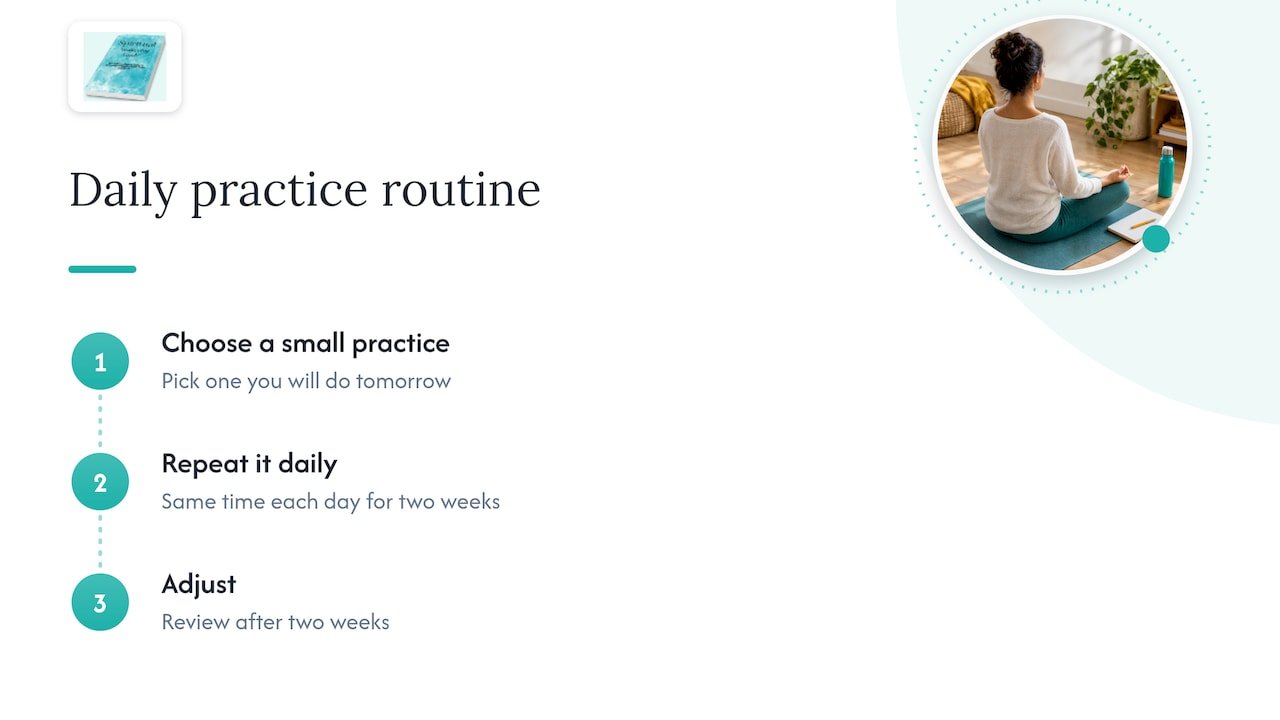
If you take one idea from this article, let it be this: choose the smallest practice you will actually do tomorrow, and do it at the same time each day for two weeks. Then adjust.
— Sean
A structured option if you prefer a guide
Some readers prefer to follow a framework instead of assembling their own. Our Spiritual awakening guide is a downloadable PDF resource priced at $20 as a one-time purchase. It includes a main ebook of more than 50 pages, a spirituality planner and journal, and a moon manifesting ritual guide, covering practices in grounding, energy clearing, sacred bathing, intention-setting, journaling and progress tracking. If you would like to read more before deciding, our 7-step guide to a transformative spiritual awakening is a good starting point, and the founder’s bio explains the background to the work.
FAQ
How do I start a spiritual awakening practice?
Begin with one short activity at the same time each day, such as five minutes of grounding or a few lines of journaling. Add a second practice after one or two weeks, once the first feels routine. Keep notes so you can see what helps.
What are some simple spiritual awakening exercises for beginners?
Good beginner exercises include slow breathing with attention on the body, a three-item gratitude list, a short loving-kindness sitting and a phone-free walk outdoors. Each takes five to fifteen minutes. If any of them cause distress, shorten the session and consider speaking with a licensed mental health professional.
How long does a spiritual awakening take?
There is no fixed timeline, and researchers describe awakening as often non-linear instead of a goal with an endpoint. Many people notice small changes in mood, attention or sleep within weeks of consistent practice, but deeper shifts unfold over months or years. Judge progress by how you live and relate to others, not by a deadline.
Can spiritual practices replace therapy?
No. Mindfulness-based programs show moderate benefits for anxiety, depression and pain, but they are complements to care, not replacements. If you have symptoms of a mental health condition, a trauma history or thoughts of self-harm, see a licensed professional, and in the U.S. call or text 988 in a crisis.
Sources
- Measuring a Journey without Goal: Meditation, Spirituality, and Physiology (PMC)
- Precautions with Using Mindful Awareness Practices (U.S. Department of Veterans Affairs)
- 988 Suicide and Crisis Lifeline mention (Valley Central)
- The Effects of Mindfulness Techniques on Anxiety, Depression, and Stress, with an Emphasis on Gratitude (PMC)
- MBSR, MBCT and Zen meditation for depression, anxiety, pain and psychological distress (PubMed)
- What Is a Mantra? Guidance for Practitioners, Researchers, and Editors (APA PsycNet)
- Stress, Meditation, and Alzheimer’s Disease Prevention (PMC)
- Journal of Consulting and Clinical Psychology manuscript on affect during meditation (APA PsycNet)
- Spiritual bypass as a moderator of religious coping and psychological distress (APA PsycNet)
- The scientific study of positive psychology, religion/spirituality, and mental health (APA PsycNet)