
Shadow work prompts are journal questions designed to surface the parts of yourself you’ve hidden, denied, or disowned, and the single best practice is to answer one prompt at a time inside a contained session rather than working through a long list at once. Start with a small selection of thoughtfully chosen prompts:
- What emotion do I judge most harshly in others, and where does it show up in me?
- What did I learn to hide about myself as a child to stay safe or loved?
- Who do I resent, and what does that resentment protect me from feeling?
- What pattern keeps repeating in my relationships that I refuse to name?
- What would I do differently if I weren’t afraid of being judged?
Write thoughtfully on one question, then pause. If a prompt brings up something bigger than you can hold alone, that’s your cue to close the journal and reach out to a therapist.
Pro Tip: Pick the prompt that makes you want to skip it. That flinch is usually where the real material lives.
Key Takeaways
Shadow work prompts work best when answered one at a time inside a time-boxed, ritualized session, followed by a deliberate integration step that turns insight into a tested behavior change.
| Point | Details |
|---|---|
| Answer one prompt at a time | Prompt-hopping through long lists functions as avoidance rather than depth. |
| Time-box every session | Use a 20 to 45 minute container with a grounding plan for afterward. |
| Follow the resistance | The prompt you want to skip usually holds the most useful material. |
| Integrate before moving on | Test one small behavior change and track it before choosing a new prompt. |
| Pause if you feel destabilized | Persistent flooding after sessions is a signal to consult a licensed therapist. |
| Use structured guides for depth | Spiritualmethod’s downloadable journals pair prompts with integration frameworks and grounding practices. |
Table of Contents
- What Are Shadow Work Prompts, Exactly?
- What Benefits Come From Shadow Work Journaling?
- How Do You Start a Shadow Work Journal?
- A Categorized Shadow Work Prompt Bank
- How Do You Process and Integrate What You Learn?
- Tips for Beginners: Staying Grounded and Safe
- Why Pacing Beats Intensity in Shadow Work
- How Spiritualmethod Supports Structured Shadow Work
- Sources
What Are Shadow Work Prompts, Exactly?
The “shadow” comes from Carl Jung, who described it as the collection of traits, impulses, and memories a person represses because they conflict with the identity they’d rather present to the world. Shadow work is the deliberate practice of bringing those disowned parts into conscious awareness, and journaling is one of the most accessible ways to do it, functioning much like the expressive-writing techniques used in psychological research to process difficult emotion through structured writing.
The difference between a regular journal prompt and a shadow work prompt is depth of exposure. A surface prompt asks “What am I grateful for today?” A shadow prompt asks “What am I pretending not to know about myself right now?” One organizes your day. The other confronts the story you tell about who you are.
Two quick comparisons make this concrete:
- Surface: “Describe a happy memory from this year.” Shadow: “Describe a memory you’ve rewritten to make yourself look better.”
- Surface: “What do I want to accomplish this month?” Shadow: “What am I avoiding accomplishing because success would change how people see me?”
These questions borrow from therapeutic frameworks like cognitive behavioral reflection, which asks you to trace a feeling back to the belief driving it, rather than just naming the feeling itself.
What Benefits Come From Shadow Work Journaling?
Readers who stick with a consistent shadow work practice tend to report a specific set of shifts, not vague “healing” but concrete behavior change:
- Sharper self-awareness about why certain comments or situations trigger outsized reactions
- Clearer boundaries in relationships, because you stop mistaking guilt for obligation
- Less projection, meaning you catch yourself blaming others for traits you haven’t owned in yourself
- Fewer reactive habits, like the urge to overexplain, people-please, or shut down during conflict
- Improved relationships, since partners and friends notice when you stop deflecting and start naming what’s actually going on
- More self-compassion, because naming a wound is different from being consumed by it
In daily life, this might look like recognizing mid-argument that you’re reacting to your mother’s voice, not your partner’s words, and choosing to pause instead of escalate. Or noticing you’ve turned down three opportunities in a row and finally asking why. These outcomes build from consistent, paced practice, not from answering fifty prompts in one weekend.
How Do You Start a Shadow Work Journal?
Shadow work rewards structure more than enthusiasm. A messy, rushed session tends to leave people activated rather than clearer, so treat setup as part of the work, not a delay before it.
- Choose exactly one prompt. Resist the pull to answer three “since you’re already in the mood.”
- Set a time-box of 20 to 45 minutes. A timer keeps the session from becoming an open-ended excavation.
- Pick a quiet space where you won’t be interrupted mid-thought.
- Decide your grounding plan before you start, whether that’s a walk, tea, or a grounding technique for anxiety relief you already know works for you.
- Write without editing. Let the answer be messy; you’re not drafting an essay.
- Close the session deliberately, even if the writing feels unfinished.
Guides on shadow work consistently emphasize pacing: work through one prompt at a time rather than several in a sitting, and treat “prompt-hopping” as a sign you’re avoiding depth rather than covering ground.
Pro Tip: Give your session a small container ritual, like lighting a candle before you write and blowing it out when you’re done. The physical bookend tells your nervous system the work has a beginning and an end, so it doesn’t bleed into the rest of your evening.

A Categorized Shadow Work Prompt Bank
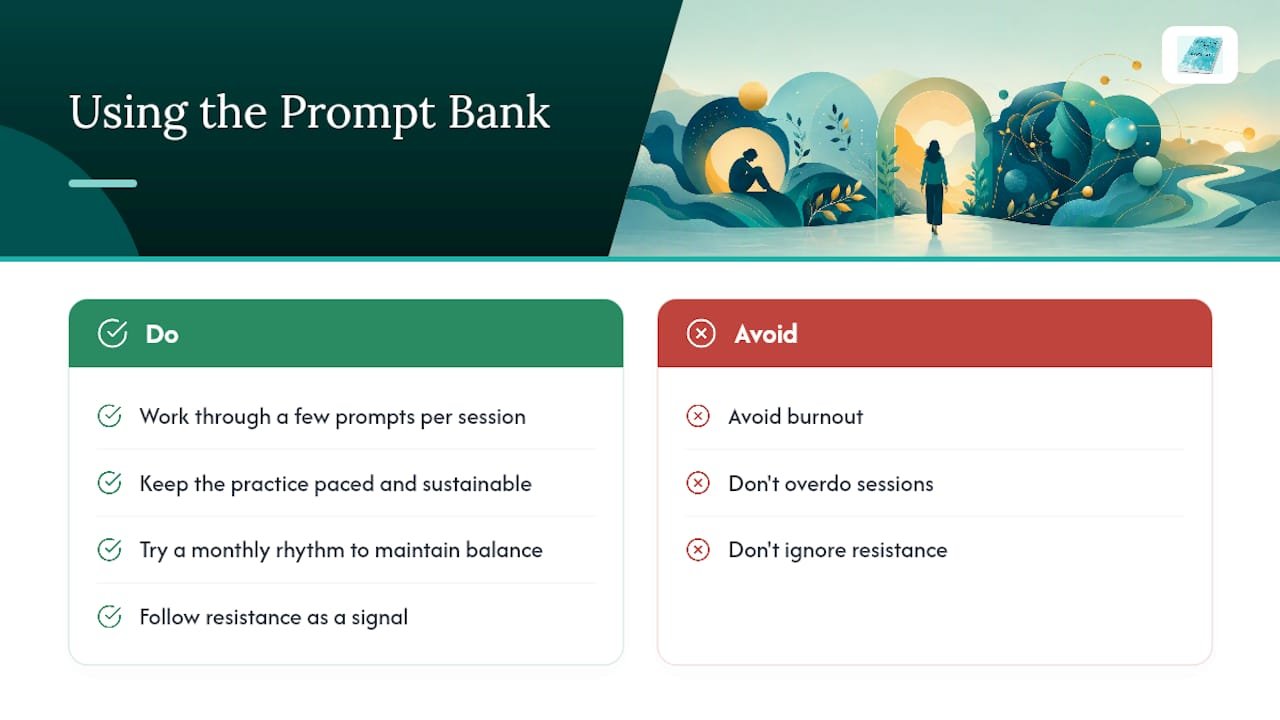
Before you dive in, a few usage notes. Work through a few prompts per session, keeping the practice paced and sustainable. Some practitioners find a monthly rhythm helpful to maintain balance and avoid burnout. When choosing which prompt to answer, notice which one you want to skip. That resistance is usually the signal worth following.
Beginner and starting-out prompts
- What part of myself have I never shown anyone?
- What do I criticize most in other people?
- What am I afraid people would think if they really knew me?
- When do I feel most like I’m “performing” instead of being myself?
- What emotion do I avoid feeling at almost any cost?
- What’s a belief about myself I’ve never questioned?
- What would I change about myself if no one would ever know?
- Who do I become when I feel unsafe?
Inner child and childhood conditioning prompts
- What did I have to do to earn love or attention as a child?
- What emotions were not allowed in my household growing up?
- What message did I absorb about my worth before age ten?
- How did I learn to make myself smaller for other people’s comfort?
- What did I need to hear as a child that I never heard?
- What role did I play in my family (peacemaker, achiever, invisible one)?
- What was I punished for feeling, and how do I still avoid feeling it?
- What would I say to my younger self about the things they blamed themselves for?
If this category resonates, a deeper set of exercises lives in this guide to inner child healing practices.
Triggers and reactions prompts
- What’s a small comment that sends me into a disproportionate reaction?
- What situation makes me want to shut down or disappear?
- When I feel disrespected, what old memory does it echo?
- What do I do the moment I feel criticized?
- What physical sensation shows up right before I lose my composure?
- Who taught me that anger, sadness, or fear was dangerous to express?
- What’s a reaction I’ve had recently that surprised even me?
- What am I really afraid will happen if I express anger directly?
Relationships and projection prompts
- What trait in my partner or friend bothers me most, and where does it live in me?
- What am I afraid to ask for in relationships?
- Who have I blamed for something I haven’t fully examined in myself?
- What pattern shows up in every romantic relationship I’ve had?
- What do I expect people to eventually do to hurt me?
- What am I not saying in my closest relationship right now?
- How do I test whether someone really cares about me?
- What would honesty cost me in my closest relationship, and why do I avoid paying it?
Self-worth and perfectionism prompts
- What achievement do I use to prove I’m worthy of love?
- What happens internally when I make a visible mistake?
- Who would I be if I stopped chasing approval?
- What standard do I hold myself to that I’d never hold a friend to?
- What do I believe will happen if I’m not the best at something?
- When did I first learn that being “enough” required effort?
- What part of my identity is built entirely on other people’s validation?
- What would I attempt if failure carried no shame?
Anger and resentment prompts
- Who am I still angry at, and what have I never told them?
- What unspoken resentment am I carrying into my daily mood?
- What did I give up that I secretly wish I hadn’t?
- What boundary have I never enforced, and what has that cost me?
- What situation do I replay in my head, wishing I’d said something different?
- Who do I envy, and what does that envy reveal about my own unmet desire?
- What anger have I turned into sarcasm or silence instead of expressing directly?
- What would I say if I allowed myself to be fully honest about my anger?
Shame and vulnerability prompts
- What’s something I’ve never told anyone out of fear of judgment?
- What do I believe makes me unlovable?
- What secret do I keep because I think it defines me?
- When did I last feel truly ashamed, and what triggered it?
- What part of my body or personality have I hated the longest?
- What would happen if I let someone see me at my lowest?
- What am I most afraid people will discover about me?
- What shame have I inherited from a parent or caregiver, not earned myself?
Self-sabotage and avoidance prompts
- What goal have I quietly abandoned more than once?
- What am I avoiding by staying busy?
- What decision have I been putting off because the answer scares me?
- What do I do the moment things start going well?
- What excuse do I reach for most often when I don’t follow through?
- What would I have to give up if I actually succeeded?
- What relationship, habit, or job am I staying in out of fear rather than desire?
- What’s the smallest honest step I’ve been avoiding for months?
Professional life and ambition prompts
- What job or role am I holding onto out of fear, not fulfillment?
- What ambition have I hidden because it feels “too much”?
- Who do I compare my career to, and why does that comparison sting?
- What would I pursue if productivity weren’t tied to my sense of worth?
- What recognition am I chasing at work that I never got at home?
- What talent have I downplayed to avoid standing out?
- What does “success” mean to me versus what I was taught it should mean?
- What work do I do that no longer aligns with who I’m becoming?
Integration and compassion prompts
- What have I learned about myself this month that I want to remember?
- What would it look like to forgive myself for a past mistake?
- What part of my shadow, once I understood it, actually makes sense?
- What small behavior change would prove I’ve integrated this insight?
- What do I want to thank my past self for surviving?
- How has naming this pattern already changed how I respond to it?
- What would compassion for myself look like today, specifically?
- What’s one thing I now understand about someone else’s behavior because I understand my own better?
How Do You Process and Integrate What You Learn?
A prompt without a plan for what comes next tends to stay an intellectual exercise instead of real change. Integration is the part most lists skip, and it’s the part that actually determines whether shadow work changes your behavior.
- Reread what you wrote, without editing it, at least a few hours after the session.
- Map the pattern: does this trigger, belief, or reaction show up in more than one area of your life?
- Choose one small behavior to test in the next week, something concrete like naming a feeling out loud instead of suppressing it.
- Track what happens. Did the old pattern show up? Did you respond differently?
- Return to the same prompt later if it still feels unresolved, rather than moving to a new one out of impatience.
Watch for red flags along the way. If you feel emotionally flooded, disoriented, or unable to function normally after a session, that’s a sign to pause the practice, not push through it. Consistent destabilization rather than steadiness after sessions is a clear signal to bring in a licensed therapist rather than continue solo journaling.
Shadow work is an ongoing practice of self-regulation. Completing a prompt matters less than sitting with the resistance it brings up, then testing a small behavior change afterward.
The research-backed rationale for limiting yourself to one prompt per session comes down to nervous system load. Deliberate pacing and a clear session container prevent the kind of emotional flooding that makes people quit shadow work altogether after one overwhelming attempt.
Pro Tip: Keep a separate “integration page” at the back of your journal where you log the one behavior change you’re testing each week. It turns insight into evidence instead of just feelings on a page.

Tips for Beginners: Staying Grounded and Safe
A few habits separate a sustainable shadow work practice from one that burns you out in a month:
- Ground yourself before and after each session with breathwork, a short walk, or physical grounding exercises.
- Keep sessions to once or twice weekly, 20 to 45 minutes each.
- Close every session with a ritual, even something as simple as closing the notebook and saying “that’s enough for today.”
- Avoid prompt-hopping. Answering many questions in one sitting often functions as avoidance disguised as productivity.
- Don’t treat shadow work as a substitute for therapy if trauma surfaces that feels too large to hold alone.
- Notice resistance and don’t ignore it. It’s information, not a failure.
Pro Tip: Schedule integration time the same way you schedule the journaling session itself. Insight without follow-up just becomes another thing you know but don’t act on.
Why Pacing Beats Intensity in Shadow Work
I’ve watched people treat shadow work like a personality quiz: answer fifty questions in an afternoon, feel briefly enlightened, then burn out within a week. That approach mistakes volume for depth. The prompt that actually changes something is usually the one you sat with for three sessions, not the one you rushed past on your way to the next.
Deep work is gradual. A single well-chosen question, revisited honestly, will teach you more than an entire workbook answered on autopilot. Give the resistance time to speak before you move on.
How Spiritualmethod Supports Structured Shadow Work
Spiritualmethod gives you what a loose list of prompts can’t: a built-out structure for the whole session, from grounding before you write to integrating what surfaces after. The Journaling for Soul Healing guide pairs prompts with the same kind of processing framework this article recommends, so you’re never left staring at a raw insight with no next step.

The guides include structured prompts organized by theme, integration exercises to turn journal entries into behavior change, grounding practices for use during intense sessions, and printable formats so you can keep a session contained without reaching for your phone. If inner child material came up while working through the prompts above, the inner child healing practices guide builds directly on that category with a full framework instead of a handful of questions.
Download the guide that matches where your shadow work is pointing you, and give your next journaling session the same structure a good therapist would bring to the conversation.
Sources
- Shadow Work Prompts: 100+ Questions for Self-Discovery – Try Conviction
- Shadow Work Prompts: 30 Questions to Begin | Grimoire
If a prompt brings up trauma or persistent distress, consult a licensed therapist rather than continuing alone.
This article is general information, not a substitute for advice from a qualified doctor. Consult a qualified healthcare professional about your own circumstances before acting on anything here.