
An intention is a quality of being you commit to in the present moment. A goal is a specific, time-bound outcome you are working toward. The difference is not trivial in practice: intentions guide how you show up, while goals define what you are trying to achieve. Use them together and you have both an emotional compass and a practical map.
Two quick-use rules to carry forward:
- Choose an intention when you need flexibility, emotional steadiness, or a values-based anchor during uncertain or emotionally charged circumstances.
- Choose a goal when you need clarity, a deadline, or a measurable target to track progress and sustain accountability.
Key Takeaways
Intentions guide how you show up; goals define what you are working toward. Using both together produces more resilient, values-aligned personal growth than either approach alone.
| Point | Details |
|---|---|
| Intention vs. goal distinction | Intentions are present-tense, values-based commitments; goals are specific, time-bound, measurable targets. |
| When to use each | Choose an intention for flexibility and emotional steadiness; choose a goal when you need a deadline and a metric. |
| Combined daily routine | A 2–10 minute daily ritual plus a 20–40 minute weekly review links intentions to measurable progress. |
| Setback recovery | Return to the intention first, then revise one variable in the goal. Avoid changing the entire plan at once. |
| Spiritualmethod tools | Downloadable journals and guides from Spiritualmethod provide structured frameworks for daily intention and goal practice. |
Table of Contents
- What is the difference between an intention and a goal?
- How intentions and goals work better together
- How to set a SMART goal and a daily intention
- How to recover when goals fail or intentions feel off
- What does the research say about combining intentions and goals?
- Concrete intention and goal pairs you can use today
- A daily and weekly routine that links intentions to measurable progress
- Why the “either/or” framing of intentions and goals misses the point
- Structured tools that support your intention and goal practice
- Sources
What is the difference between an intention and a goal?
Defining intentions as the “how” and goals as the “what” is one of the clearest frameworks available for personal growth. Each concept has a distinct structure, and understanding that structure makes it far easier to use both well.
Intention defined: An intention is a present-tense commitment to a way of being. It is not a destination. “Be present” is an intention. So is “act with patience” or “show up with curiosity.” The practice begins now, not when a condition is met.
Goal defined: A goal is a future-oriented target with a defined outcome. “Run a 5K by September 30” is a goal. It has a specific result, a deadline, and a clear pass/fail condition.
The five dimensions below show where the two concepts diverge most clearly.
| Dimension | Intention | Goal |
|---|---|---|
| Specificity | Broad, values-based | Specific, outcome-defined |
| Timeframe | Ongoing, open-ended | Time-bound, deadline-driven |
| Measurability | Qualitative, felt sense | Quantitative, trackable |
| Mindset | Values and “why” | Outcome and “how” |
| Flexibility | Adaptable, revisable | Fixed until achieved or revised |
The practical implication of each dimension: specificity tells you how to write the statement; timeframe tells you when to revisit it; measurability tells you how to know it is working; mindset tells you what question to ask when you feel stuck; and flexibility tells you how much permission you have to adapt without abandoning the practice.
How intentions and goals work better together
Goals without intentions tend to become brittle. You hit a setback, miss a milestone, and the entire plan feels like a failure. Intentions without goals can stay abstract indefinitely, producing a pleasant sense of purpose without measurable progress. The combination resolves both problems.
Combining goals and intentions reduces the emotional cost of missed targets by shifting some of the focus from outcome to process. The goal provides structure and milestones; the intention provides meaning and a way to stay steady when the milestones slip.
Consider a practical example. A person sets a goal to write 500 words of a personal essay every weekday for four weeks. Midway through week two, a difficult week at work leaves her with three missed days and a growing sense of defeat. Because she also set the intention “create with honesty,” she is able to return to the desk not as someone who failed a word count, but as someone recommitting to a quality she values. The goal gives her a target to recalibrate; the intention gives her a reason to return at all.

Leaders who align in-the-moment intentions with longer-term goals report better collaboration and fewer reactive behaviors under stress. That pattern holds in personal growth contexts too.
When to prioritize an intention over a goal: During high-stress periods, grief, major transitions, or any time when rigid targets would add pressure rather than clarity. An intention keeps you oriented without demanding performance.
When to prioritize a goal: When you have a clear outcome in mind, a realistic timeline, and the stability to track progress without the tracking itself becoming a source of anxiety.
Common misalignment pitfall: Setting an intention that contradicts the implicit demands of the goal. If your goal requires aggressive daily output and your intention is “rest deeply,” the two will create friction rather than synergy. Align them before you begin.
How to set a SMART goal and a daily intention
Practical templates make the difference between a concept that sounds useful and one that actually changes behavior. The following frameworks are designed to be used together.
Setting a SMART goal
SMART stands for Specific, Measurable, Achievable, Relevant, and Time-bound. Work through each element in order:
- Specific: Write the outcome in one sentence. Name the exact behavior or result. “Improve my fitness” is not specific. “Complete three 30-minute strength workouts per week” is.
- Measurable: Identify the metric. How will you know you have succeeded? A number, a date, a completed artifact.
- Achievable: Check the goal against your current schedule and resources. If it requires conditions you do not have, scale it down until it is realistic.
- Relevant: Confirm the goal connects to a value or larger priority. A goal that does not matter to you will not survive the first obstacle.
- Time-bound: Set a specific end date. Open-ended goals rarely get finished.
Setting a daily intention
Setting intentions is a mindful practice focused on values and present-moment embodiment rather than rigid targets. The following routine takes two to five minutes and can anchor any morning.
- Sit quietly for 60 seconds. Notice your current state without judgment.
- Ask: “What quality do I want to bring to today?” Let one word or short phrase surface. Common one-word intentions include: presence, patience, clarity, courage, ease.
- Write it down. One line is enough.
- Set a midday check-in reminder. When it fires, ask: “Am I living this intention right now?”
- At the end of the day, write one sentence about where the intention showed up and where it did not.
Pro Tip: Practitioners recommend one-word intentions over full sentences because a single word is easier to recall under pressure. “Patience” is retrievable in a difficult meeting; a full sentence is not.
Journaling prompts to connect intention to goal
Structured tools such as journals and planners help translate intentions into daily choices and connect those choices to longer-term goals. Use these prompts weekly:
- What is my one-word intention for this week, and why does it matter to me right now?
- Which of my current goals aligns most directly with this intention?
- What is one specific action I can take today that honors both the intention and the goal?
- Where did I act against my intention this week, and what would I do differently?
- What does progress look like for my goal this week, in measurable terms?
A morning intention-setting ritual that includes one of these prompts takes under ten minutes and creates a direct link between your values and your daily schedule.
How to recover when goals fail or intentions feel off
Setbacks are not evidence that the system is broken. They are data. The question is how to read that data quickly and return to productive practice.
Immediate repair after a setback: When a goal is missed or an intention feels hollow, resist the urge to either abandon the plan or double down with more pressure. Instead, pause for five minutes and write answers to two questions: “What actually happened?” and “What did I want to happen?” The gap between those two answers is where the useful information lives.
Diagnostic questions for revision:
- Did I miss the goal because the target was unrealistic, or because my circumstances changed?
- Does my intention still reflect a quality I genuinely value, or has it become a performance?
- Is the action plan between intention and goal specific enough to follow on a difficult day?
If the goal was unrealistic, revise the metric or the deadline. If the intention has become performative, return to the original question: “What quality do I actually want to bring to this area of my life?” If the action plan is vague, add specificity using if-then structure: “If it is 7:00 AM on a weekday, then I will write for 20 minutes before opening email.”
Intentions reduce the all-or-nothing pressure of resolutions and support incremental habit change by allowing immediate, present-moment practice. That quality is what makes them particularly useful after a setback: you do not need to restart a streak or make up lost ground. You simply return to the intention now.
A micro-routine for regaining momentum: Take 15 minutes in a single session. Write your intention at the top of a page. List three actions you can take in the next 48 hours that align with it. Choose one and schedule it before you close the notebook. That single committed next action is enough to restore forward motion.
Pro Tip: When revising a goal after a setback, change only one variable at a time. Adjusting the deadline, the metric, and the action plan simultaneously makes it impossible to learn which change actually helped.
What does the research say about combining intentions and goals?
The psychological case for using intentions alongside goals is well-established, though the mechanisms differ depending on the context.
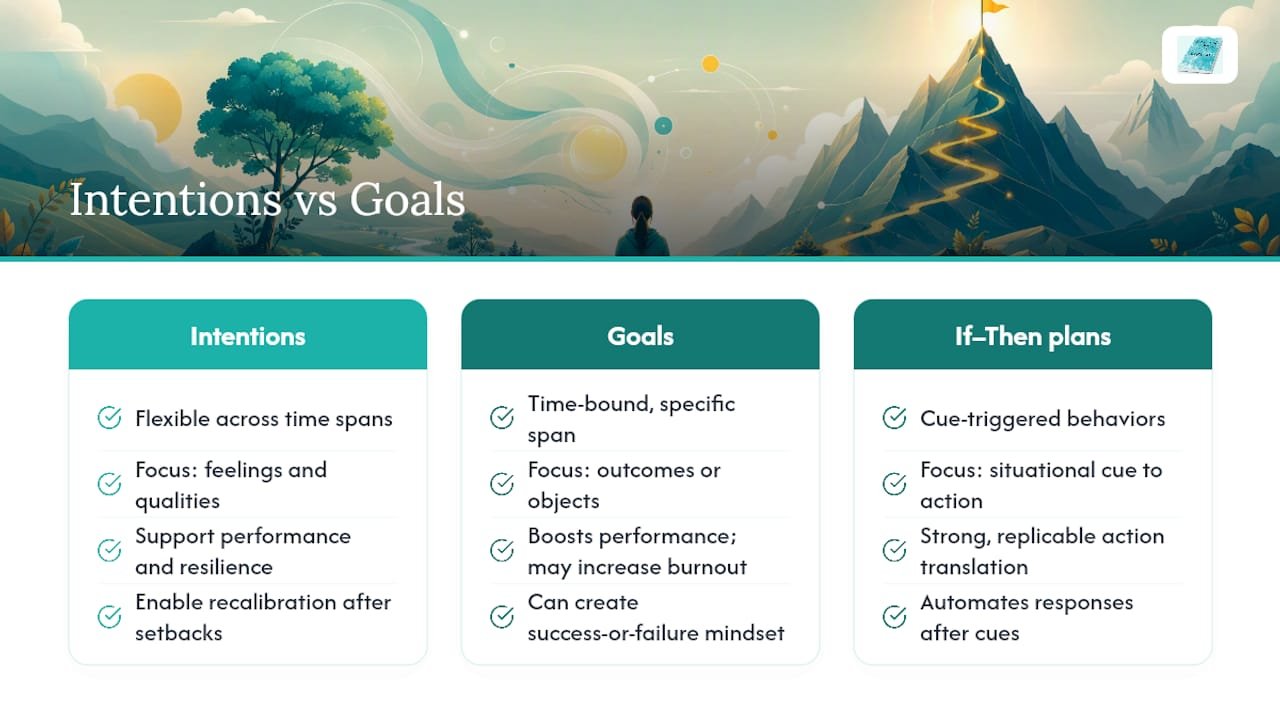
Intentions act as a flexible compass that can be set for any time span and support performance and resilience in both personal and professional settings. The flexibility is not a weakness; it is the feature that allows intentions to survive the conditions that cause rigid resolutions to collapse.
The most precise evidence comes from implementation-intentions research, which shows strong, replicable effects for specifying situational cues that trigger goal-directed behaviors. The structure is simple: “If situation X occurs, then I will perform behavior Y.” This if-then format bridges the gap between a stated intention and consistent action, making it one of the highest-leverage techniques available for personal growth.
Research note: Implementation-intentions produce strong effects on translating stated intentions into reliable action across a wide range of goal types, from health behaviors to academic performance.
Practitioners working in wellness and spiritual development favor intention boards and structured planners over traditional vision boards when the aim is inner growth rather than material acquisition. The distinction matters: an intention board focuses on feelings and qualities of being, while a vision board typically centers on specific outcomes or objects. For readers interested in vision board alternatives, intention boards and structured journals offer a more adaptable and process-oriented approach.
Psychologically, goals can create a success-or-failure mindset that increases burnout risk. Intentions act as a stabilizing element, enabling recalibration after setbacks without requiring the entire plan to be rebuilt. Self-care planners that integrate both intention prompts and goal-tracking sections reflect this dual structure in a practical format.
Concrete intention and goal pairs you can use today
The following paired examples cover four common growth areas. Each pair shows a one-word or short-phrase intention alongside a matching SMART goal.
| Area | Intention | Matching SMART goal |
|---|---|---|
| Health | Nourish | Cook three home meals per week |
| Health | Move | Complete four 20-minute walks per week through October |
| Work | Focus | Spend focused time on deep work before checking email, 5 days per week |
| Work | Contribute | Deliver one written project update to the team every Friday for 6 weeks |
| Relationships | Listen | Have one phone-free, 30-minute conversation with a close friend each week for a month |
| Relationships | Presence | Write one gratitude note to a family member weekly for 4 weeks |
| Creativity | Explore | Spend 20 minutes on a creative practice 3 times per week for 6 weeks |
| Creativity | Finish | Complete one creative project draft by the end of the current month |
Ready-to-use one-word intentions: Clarity, Ease, Courage, Patience, Openness, Steadiness, Warmth, Focus, Trust, Simplicity.
Matching daily micro-actions for any of these intentions follow the same pattern: identify one behavior that expresses the intention, schedule it at a specific time, and note it in a journal at the end of the day.
A 7-day trial template
Use this template to test a combined intention and goal routine for one week:
- Day 1: Write your one-word intention and one SMART goal for the week. Set a midday check-in reminder.
- Day 2: Complete your first goal-aligned action. Journal one sentence about how the intention showed up.
- Day 3: Midday check-in: rate your alignment with the intention on a 1–5 scale. Adjust your afternoon accordingly.
- Day 4: Rest or lighter practice day. Revisit your intention. Does it still feel true?
- Day 5: Complete your second goal-aligned action. Note any resistance and what it tells you.
- Day 6: Write answers to two prompts: “Where did I honor my intention this week?” and “What measurable progress did I make toward my goal?”
- Day 7: Weekly review. Revise the intention or goal as needed. Set the next week’s pair.
A daily and weekly routine that links intentions to measurable progress
The routine below is designed to be minimal. It requires no special equipment, fits into existing schedules, and scales up or down depending on available time.
Daily ritual (2–10 minutes)
- Morning (2–3 minutes): Write your one-word intention. Read your current SMART goal. Write one sentence connecting them: “Today, I will [specific action] as an expression of [intention].”
- Midday check-in (1 minute): Ask yourself: “Am I living my intention right now?” Adjust if needed. No journaling required at this step.
- Evening reflection (2–5 minutes): Write one sentence about where the intention showed up and one sentence about progress toward the goal. Note the next day’s first goal-aligned action.
Weekly review (20–40 minutes)
- Review the week’s evening reflections. Identify patterns.
- Assess goal progress: How many of the planned actions were completed? What percentage of the target was reached?
- Ask: Does the intention still reflect a quality I want to cultivate, or has it served its purpose?
- Set the next week’s intention and adjust the goal’s action plan if needed.
- Write one sentence of acknowledgment for what was completed, regardless of whether the full goal was met.
Time budget: The daily ritual costs 5–10 minutes. The weekly review costs 20–40 minutes. Total weekly investment: roughly 55–110 minutes.
Accountability options: Self-check journaling is sufficient for most people. A daily spiritual practice that includes structured reflection can serve the same function with added depth. For those who prefer external accountability, sharing the weekly review with a trusted person or community adds a layer of commitment without requiring a formal coach.
Revision guidelines: Intentions can be revised as often as weekly, especially during periods of change. Goals should be revised when circumstances shift significantly, but not more than once per month during stable periods. Frequent goal revision signals either an unrealistic original target or insufficient commitment to the action plan.
Why the “either/or” framing of intentions and goals misses the point
Most people approach personal growth as a choice between structure and flexibility. Either you set rigid goals and grind toward them, or you stay soft and values-focused and hope things work out. That framing is not just unhelpful. It is the reason so many growth plans collapse within weeks.
The evidence points clearly in one direction: aligned intentions and goals together allow you to choose actions that reflect your values rather than react to temporary negative emotions. That is a meaningful distinction. A goal without an intention is just a deadline. An intention without a goal is just a mood. Neither one alone produces durable change.
What practitioners in spiritual development and performance psychology have understood for some time is that the “how” and the “what” are not competing priorities. They are sequential. You start with the intention, let it clarify your values, and then let the goal emerge from that clarity. When the goal is rooted in a genuine intention, setbacks feel like course corrections rather than failures. The plan becomes something you return to rather than something you abandon.
The structured guides and journals available through Spiritualmethod are built around exactly this sequence: intention first, then structured goal-setting, then daily practice. That order is not arbitrary. It reflects how durable personal growth actually works.
Structured tools that support your intention and goal practice
Readers who want to move from concept to consistent practice often find that a structured guide shortens the gap considerably.

Spiritualmethod’s downloadable guides are built for exactly the routines described in this article. The journaling for soul healing guide includes structured prompts for daily intention-setting, weekly goal review, and reflection practices that connect values to measurable progress. For readers working through deeper personal growth, the inner child healing practices guide pairs intention work with structured healing exercises in a single downloadable PDF. Both are available for immediate download, with no subscription required. If you are ready to move from reading about intentions and goals to practicing them with a clear framework, either guide offers a concrete starting point.
Sources
The following sources informed the research and practical frameworks in this article. Each offers additional depth on the psychology and practice of setting intentions and goals.
- Resolutions or Intentions: Which Lead to Genuine Change? | Psychology Today
- How to create an intention board | Jed Foundation
- The Powerful Combination Of Aligned Goals And Intentions | Forbes
- Making the Most Out of Setting Intentions | Cleveland Clinic
- Implementation intentions: Strong effects of simple plans | Semantic Scholar