
Deep inner work is the deliberate practice of turning attention inward to integrate repressed emotions, shadow aspects, and body-stored trauma patterns so that you become more whole rather than simply more managed. If you have spent years reading self-help books, attending workshops, or maintaining a meditation habit and still feel like something fundamental has not shifted, this is the practice that addresses why.
TL;DR
- Deep inner work targets the root causes of stuck patterns, not the symptoms. It builds lasting capacity in your nervous system and psyche, not just better habits on the surface.
- It differs from surface-level self-care in that it requires you to feel and integrate difficult material, not organize around it or think your way past it. The American Psychological Association recognizes trauma-informed approaches as foundational to this kind of healing.
- The main risk is spiritual bypassing: using spiritual ideas or practices to avoid feeling what needs to be felt. Spiritualmethod’s structured guides and SAMHSA’s National Helpline are useful anchors for staying grounded in real practice.
Quick action you can try in 60 seconds: Place both feet flat on the floor. Press them down firmly and notice the pressure. Take one slow breath in through your nose for four counts, hold for two, and exhale for six. Ask yourself: “Where in my body do I feel tension right now?” Simply notice. That single moment of body-directed attention is the entry point to everything this article covers.
Table of Contents
- What does deep inner work really mean?
- How do you know you need deeper inner work?
- What are the core methods used in deep inner work?
- Why embodiment matters more than insight alone
- What are the common pitfalls and safety risks in inner work?
- How long does inner work take, and how do you track progress?
- A safe 4-week starter plan for beginning inner work
- When should you seek trauma-informed professional help?
- Key Takeaways
- Why starting with the body changes everything
- Structured support for your inner healing practice
- Useful sources and further reading
What does deep inner work really mean?
Deep inner work is sometimes called “The Great Work” in psychological and spiritual traditions, a phrase that signals its scope. It is not a weekend retreat or a journaling habit, though both can be part of it. It is a sustained discipline of making the unconscious conscious, specifically by integrating the parts of yourself that were suppressed, shamed, or stored in the body before you had the language or safety to process them.
The practice rests on six interlocking components.
| Component | What it involves |
|---|---|
| Awareness | Developing the capacity to observe thoughts, emotions, and body sensations without immediately reacting |
| Shadow work | Reclaiming disowned parts of the self that were judged unacceptable during development |
| Emotional integration | Allowing repressed feelings to surface, be felt fully, and be metabolized rather than managed |
| Somatic regulation | Working with the body and nervous system directly, since patterns are stored in tissue and autonomic response, not only in memory |
| Narrative reprocessing | Revisiting and updating the stories you carry about yourself and your past |
| Spiritual integration | Connecting fragmented experience to a larger sense of meaning and wholeness, sometimes called individuation |
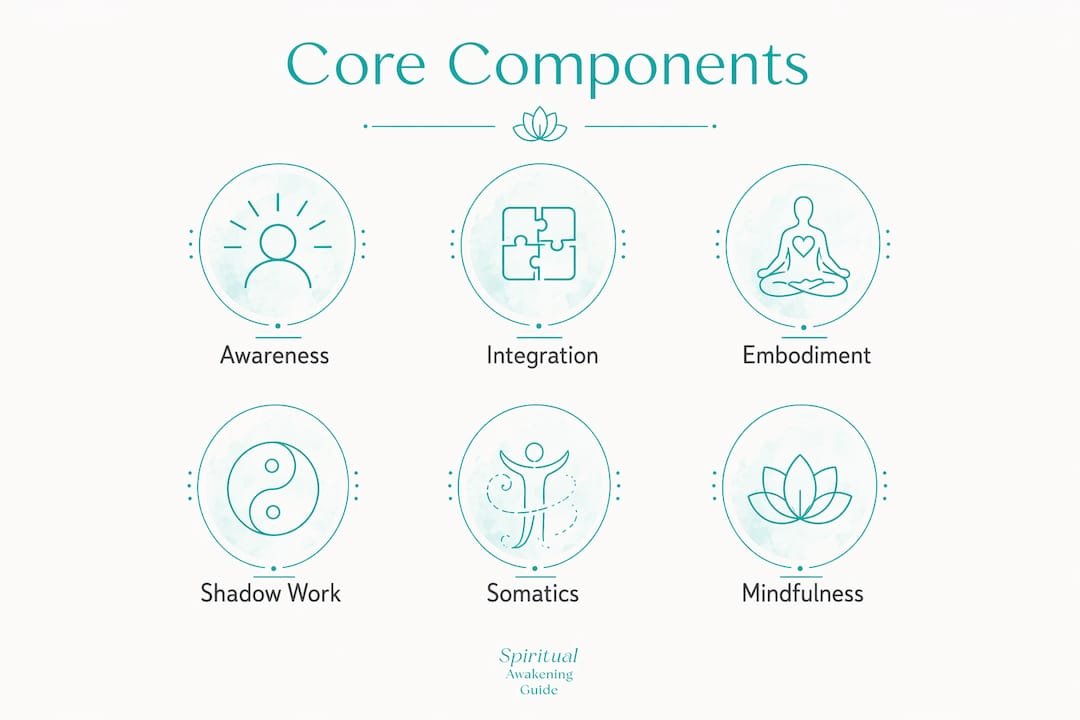
Surface-level self-help, by contrast, focuses on symptom management: building better habits, improving productivity, or practicing self-care checklists. These approaches have real value, but they operate at the level of behavior and conscious thought. Deep inner work operates at the level of capacity. It asks not “How can I do better?” but “What is preventing me from being different?”
Consider journaling as an illustration. Using a journal to plan your week or track gratitude is a surface practice. Using it to write freely about a moment of shame from childhood, then sitting with the physical sensation that arises in your chest, then asking what that younger version of you needed, is inner work. The difference is not the tool. It is the depth of contact you are willing to make with what is actually there.
How do you know you need deeper inner work?
Most people arrive at deep inner work after noticing that their existing approaches have stopped producing change. The following signs suggest that surface-level self-help has reached its limit and that something more foundational is called for.
- Repeated relational patterns. You keep attracting or becoming the same dynamic in relationships, despite awareness of the pattern and genuine effort to change it.
- A “trauma-driven ceiling.” You make progress up to a point, then stall. Practitioners describe this as the nervous system or body-based memory blocking further growth even when cognitive insight is present.
- Chronic shame or guilt that does not respond to positive thinking, reframing, or affirmation.
- Stuckness despite therapy or self-help. You have done the work intellectually but still feel the same way in your body or in triggering situations.
- Frequent emotional reactivity that feels disproportionate to the present moment, suggesting an older wound is being activated.
- Spiritual bypassing tendencies. You notice yourself reaching for spiritual concepts, practices, or community to avoid sitting with difficult feelings rather than to support processing them.
Self-assessment prompts: Spend two minutes with each of these questions, writing whatever comes without editing.
- “What pattern in my relationships keeps repeating, even when I try to change it?”
- “When I feel most stuck in life, where do I feel it in my body?”
- “What emotion do I most consistently avoid, and what do I do instead of feeling it?”
If your answers point to body sensations (tightness in the chest, a hollow feeling in the stomach, a freeze response in conflict), that is a signal that the issue is likely stored somatically, not just narratively. Talking about it may help, but body-based approaches are often necessary to shift the pattern at its root.
What are the core methods used in deep inner work?
Practitioners generally agree that an ecology of practices produces more durable change than any single method used sporadically. The most effective structure combines a stable base practice, one processing method, and one somatic modality.
Journaling for integration
Journaling for integration differs from diary-keeping in that it is directed toward a specific wound or pattern. Begin with a prompt, write without stopping for ten minutes, then pause and notice what you feel in your body. The body response is the data.
Sample prompts:
- “The first time I learned it was not safe to feel angry was…”
- “The part of me I most want others not to see is…”
- “If I let myself fully grieve [specific loss], what I would feel is…”
For structured prompts and a guided framework, Spiritualmethod’s journaling for soul healing guide provides a sequenced approach that pairs written reflection with somatic check-ins.
Shadow work
Shadow work focuses specifically on the parts of yourself you have disowned: the anger you were told was unacceptable, the neediness you learned to hide, the grief you never expressed. The practice involves identifying a quality you strongly judge in others, then asking where that quality lives in you. It is not comfortable work, and it is best approached with a grounded nervous system first. For readers who integrate ritual with psychological methods, exploring shadow work through tarot archetypes can offer a structured, symbolic entry point into this material.
Inner-child exercises
Inner-child work involves making deliberate contact with younger versions of yourself who experienced unmet needs or overwhelming events. A simple entry point: close your eyes, bring to mind a memory of yourself at age seven or eight, and ask that younger self what they most needed to hear. Then say it, aloud or in writing. Spiritualmethod’s inner-child healing guide offers a structured sequence for this practice.
Somatic and body-based practices
Somatic practices work directly with the nervous system. Breathwork, tension-and-tremor release exercises (sometimes called TRE-style work), and grounding sequences all help regulate the autonomic response before and after processing sessions. These are capacity-building tools, not processing tools in themselves. They prepare the system to tolerate deeper contact with difficult material.

Mindfulness as a base practice
Mindfulness meditation builds the foundational skill of observing experience without immediately reacting to it. Without this capacity, deeper practices can become overwhelming. A consistent ten-minute daily sitting practice, focused on breath and body sensation, creates the internal stability that makes other methods safer to use.
Evidence-based therapy modalities
For trauma that is complex or long-standing, professional modalities offer structured support. EMDR (Eye Movement Desensitization and Reprocessing) is one well-researched option for processing specific traumatic memories. Trauma-informed therapy, somatic experiencing, and Internal Family Systems (IFS) are others. These are not substitutes for self-practice, but they provide a container that solo work cannot replicate.
Pro Tip: Start with capacity-building before processing. Spend at least two weeks on grounding and breathwork before introducing shadow work or inner-child exercises. A regulated nervous system is the prerequisite, not an optional warm-up.
Why embodiment matters more than insight alone
Trauma is stored in the body. This is not a metaphor. Modern trauma research, shaped significantly by the work of Bessel van der Kolk, demonstrates that body-stored trauma shows up as physical sensations, chronic tension, and autonomic reactivity that narrative memory alone cannot resolve. Talk therapy can produce profound insight while leaving the body’s response entirely unchanged.
Practitioners describe a consistent pattern: a person understands their trauma intellectually, can articulate its origins clearly, and still freezes, collapses, or rages in the situations that activate it. The understanding lives in the cortex; the pattern lives in the nervous system. Somatic work addresses the second location.
“Trauma is not what happened to you. It is what happened inside you as a result of what happened to you. Healing, therefore, is not about changing the past. It is about changing your relationship to what the past left in your body.” This framing, drawn from contemporary somatic and trauma-informed practice, is the foundation for why embodied approaches are not supplementary to inner work. They are central to it.
Three short embodiment exercises
3-minute grounding sequence. Stand or sit with your feet flat on the floor. Press down and feel the ground pushing back. Slowly look around the room, naming five objects you can see. Take three slow breaths, extending the exhale to twice the length of the inhale. Notice whether your shoulders have dropped or your jaw has softened. This sequence signals safety to the nervous system before any processing begins.

Orienting breath. Sit comfortably and let your gaze soften. Without forcing it, allow your eyes to move slowly around the room, pausing wherever they naturally want to rest. This is the orienting response, a built-in nervous-system function that signals “no threat present.” Pair it with slow, natural breathing for two minutes. Many people notice a spontaneous exhale or a slight trembling in the hands, both signs of nervous-system release.
Safe movement. Stand and shake your hands loosely from the wrists for thirty seconds. Then let the shaking travel up your arms and into your shoulders. Allow any natural movement that wants to happen without directing it. This is a simplified version of tension-and-tremor release and can discharge accumulated stress held in the muscles. For a more complete sequence, Spiritualmethod’s grounding exercises guide walks through this process step by step.
Pro Tip: Scale intensity by tracking your “window of tolerance.” If an exercise produces dissociation, numbness, or a sense of being overwhelmed, it is too intense for your current capacity. Return to grounding and reduce the duration or depth of the practice. Capacity expands gradually, not by pushing through.
What are the common pitfalls and safety risks in inner work?
Spiritual bypassing
Spiritual bypassing is the use of spiritual ideas, practices, or community to avoid feeling and processing difficult emotions. It shows up in recognizable forms: meditating to escape anxiety rather than to observe it, using forgiveness as a way to skip grief, or framing every difficult feeling as “just the ego” without actually sitting with it. Bypassing feels like progress because it is comfortable and socially rewarded in spiritual communities. It is not progress. It is avoidance with better vocabulary. For a deeper examination of how bypassing operates and how to recognize it in your own practice, Spiritualmethod’s guide on spiritual bypassing covers the most common patterns.
DIY re-traumatization
Attempting deep processing work without adequate capacity or support can reactivate trauma without completing the processing cycle. This leaves a person more dysregulated than before. The risk is highest when working with complex or developmental trauma, or when there is no grounding practice in place.
Safety checklist before beginning a session:
- Your nervous system feels regulated (not in acute stress or shutdown).
- You have at least thirty minutes of uninterrupted time after the session for integration.
- You have a grounding practice you can use if the session becomes too intense.
- You are not in an active crisis (recent loss, acute mental health episode, or major life disruption).
- You have identified a support person or professional you can contact if needed.
Red flags that indicate immediate professional support is needed:
- Dissociation during or after a practice (feeling detached from your body, surroundings, or sense of self).
- Suicidal ideation or thoughts of self-harm.
- Overwhelming flashbacks that do not resolve with grounding.
- Persistent functional impairment (inability to work, sleep, or maintain basic self-care) following a session.
If any of these are present, pause solo practice and contact a trauma-informed professional. SAMHSA’s National Helpline (1-800-662-4357) is available 24 hours a day, seven days a week, at no cost.
Pro Tip: Build an “integration window” into every session. For every ten minutes of processing work, allow at least five minutes of grounding and gentle movement afterward. Processing without integration is like opening a wound without closing it.
How long does inner work take, and how do you track progress?
There is no fixed timeline. Inner work is frequently described as a lifelong practice rather than a task with a completion date. Success is measured by increased self-awareness and expanded capacity, not by achieving a permanently “healed” state. Expecting to finish is one of the most common sources of discouragement.
Short-term changes (weeks to months) tend to look like: reduced intensity of a specific trigger, a new ability to pause before reacting, or increased awareness of a pattern in real time rather than only in retrospect. Long-term capacity shifts (months to years) look like: consistent emotional regulation across a range of situations, integrated relationships with previously disowned parts of the self, and a stable sense of identity that does not depend on external validation.
A practical way to track progress is to measure your relationship to specific triggers over time, not your general sense of wellness.
| Symptom or trigger | Baseline reaction | Desired shift | Small experiment |
|---|---|---|---|
| Conflict with a close person | Immediate shutdown or rage | Pause, feel the sensation, stay present | Practice the orienting breath before responding |
| Shame spiral after a mistake | Hours of self-criticism | Notice the spiral within minutes, apply self-compassion | Write one sentence of self-compassion immediately after the mistake |
| Anxiety in social situations | Avoidance or performance | Tolerate discomfort for five minutes longer | Attend one event with a grounding practice beforehand |
| Emotional numbness | Disconnection from feelings | Notice one body sensation per day | Daily two-minute body scan |
Copy this template and revisit it monthly. The goal is not to eliminate the trigger but to change your relationship to it.
A safe 4-week starter plan for beginning inner work
This plan is designed for beginners with no prior formal practice. It follows the principle that capacity must be built before processing begins. Each week adds one layer without removing the previous one.
| Week | Focus | Primary practice | Weekly integration |
|---|---|---|---|
| Week 1 | Awareness and grounding | 10-minute daily body scan; 3-minute grounding sequence | One journaling session: “What did I notice in my body this week?” |
| Week 2 | Somatic regulation | Add orienting breath and safe movement to daily practice | One journaling session using an integration prompt |
| Week 3 | Shadow inquiry | Add one shadow work prompt per day after grounding | Review the week’s journal entries and note recurring themes |
| Week 4 | Integration and ritual | Combine all practices; add one intention-setting or closing ritual | Write a short letter to yourself summarizing what you have learned |
Daily practice checklist (5–15 minutes):
- Morning grounding sequence (3 minutes).
- One journaling prompt, written without editing (5–10 minutes).
- Brief body check-in before sleep: “Where am I holding tension? What emotion is present?”
Safety reminders:
- If Week 3 shadow work feels too intense, return to Week 2 for another week before proceeding.
- Never skip the grounding sequence before a processing session.
- If you experience dissociation, numbness, or persistent distress, pause the plan and consult a professional.
For daily practice support, Spiritualmethod’s daily spiritual practices guide offers structured micro-practices that complement each week of this plan.
Pro Tip: Commit to one practice for three full weeks before evaluating whether it is working. The most common reason inner work fails is not that the method is wrong, but that it was abandoned before the nervous system had time to respond.
When should you seek trauma-informed professional help?
Solo practice has real limits. The following indicators suggest that professional support is not just helpful but necessary.
- Dissociation that does not resolve with grounding.
- Suicidal ideation or thoughts of self-harm at any level.
- Immobilizing panic that prevents daily functioning.
- Persistent functional impairment lasting more than two weeks after beginning a practice.
- A history of complex or developmental trauma (childhood abuse, neglect, or repeated relational trauma).
When seeking a therapist or practitioner, the following questions help identify someone with appropriate training.
- “What trauma-informed modalities do you use?” (Look for: EMDR, somatic experiencing, IFS, or trauma-focused CBT.)
- “How do you approach somatic or body-based work in sessions?”
- “What does your integration plan look like between sessions?”
- “Do you have specific training in developmental or complex trauma?”
Reputable US directories for finding vetted professionals:
The APA’s therapist locator allows you to search by specialty, including trauma. SAMHSA’s treatment locator covers mental health and substance use services nationwide. Psychology Today’s directory allows filtering by trauma-informed approach and sliding-scale fee availability.
Pro Tip: A good trauma-informed therapist will spend the first several sessions building your capacity and the therapeutic relationship before introducing any processing work. If a practitioner moves immediately into deep trauma processing in the first session, that is a red flag, not a sign of efficiency.
Key Takeaways
Deep inner work builds lasting psychological and somatic capacity by integrating shadow, repressed emotion, and body-stored trauma patterns rather than managing surface symptoms.
| Point | Details |
|---|---|
| Definition and scope | Deep inner work integrates shadow, trauma, and body-stored patterns for lasting wholeness, not just better habits. |
| Embodiment is central | Somatic practices are necessary because trauma is stored in the body and nervous system, not only in narrative memory. |
| Safety before processing | Build grounding and regulation capacity for at least two weeks before introducing shadow work or inner-child exercises. |
| Progress is relational | Track your relationship to specific triggers over time, not a general sense of being “healed.” |
| Spiritualmethod resources | Spiritualmethod’s downloadable guides on journaling, grounding, and inner-child healing provide structured support for each stage of the starter plan. |
Why starting with the body changes everything
The conventional approach to personal growth places cognitive insight at the center: read the right book, understand the pattern, choose differently. That sequence works for surface-level habits. For deep inner work, it consistently falls short, and the reason is physiological. The nervous system does not respond to understanding. It responds to repeated experience of safety, regulation, and gradual exposure to previously overwhelming material.
Starting with embodied practices, specifically grounding, breathwork, and somatic awareness, before introducing heavy cognitive or emotional processing is not the cautious route. It is the effective one. A person who spends two weeks building somatic capacity before their first shadow work session will go further and more safely than someone who dives into deep processing from a dysregulated baseline. The body is not an obstacle to inner work. It is the primary location where inner work happens.
There is also a longer-term caution worth naming. A pattern sometimes called spiritual narcissism can emerge after years of practice: the belief that you have “arrived,” that the work is complete. Inner work is cyclical. Claiming finality often precedes a re-emergence of shadow material, usually in a more refined form. The most experienced practitioners tend to hold their progress lightly and remain curious rather than certain.
Structured support for your inner healing practice
If the starter plan in this article resonates with you, Spiritualmethod’s downloadable guides offer a structured next step that goes considerably deeper than what a single article can provide.

The flagship 50+ page inner-healing ebook covers grounding, energy clearing, sacred bathing rituals, and intention-setting within a coherent framework, so you are not assembling practices from scattered sources. The spirituality planner and journal pairs directly with the journaling prompts in this article, providing sequenced reflection exercises and progress-tracking pages designed for the kind of integration work described above. For readers who want to begin with the body, the mind-body connection exercises guide provides step-by-step somatic practices that align with the 4-week starter plan.
Readers dealing with complex or developmental trauma are encouraged to use these guides alongside, not instead of, professional support. For structured inner-child healing in particular, the inner-child healing practices guide provides a sequenced approach that complements trauma-informed therapy. Browse the full collection at Spiritualmethod and choose the guide that matches where you are right now.
Useful sources and further reading
| Resource | Type | Description |
|---|---|---|
| SAMHSA National Helpline | Crisis and referral | Free, confidential, always-available treatment referral service for mental health and substance use; includes trauma-informed care options. |
| APA Therapist Locator | Directory | American Psychological Association’s guide to finding effective, evidence-based treatment, searchable by specialty. |
| SAMHSA Treatment Locator | Directory | Federal database for finding mental health and substance use treatment providers across the United States. |
| What Is Inner Work? — LonerWolf | Practitioner article | Comprehensive overview of inner work components including shadow work and individuation, grounded in Jungian psychology. |
| Inner Work for Social Change | Framework | Defines inner work as deliberate reflective practice that increases awareness of self, others, and systems; useful for understanding the broader scope of the practice. |
| A Model for Deep Healing vs Growth — Medium | Practitioner article | Distinguishes capacity-building from processing work and explains why somatic modalities are often necessary for lasting change. |
| Deep Inner Work: Pathways to Transformation — Artem Zen | Practitioner article | Introduces the ecology-of-practices model and explains why consistency across a small set of methods outperforms sporadic experimentation. |
| MindlyWave: Inner Work Psychology and Spirituality | Practitioner article | Covers the psychological and spiritual dimensions of inner work, including spiritual bypassing and somatic regulation. |
| Spiritualmethod Grounding Guide | Downloadable guide | Step-by-step grounding exercises for daily practice, suitable for beginners building somatic capacity. |
| Spiritualmethod Journaling Guide | Downloadable guide | Sequenced journaling prompts and integration exercises for soul-level healing work. |
| Shadow and Healing Tarot Spread — Tarosyn | Partner resource | Structured tarot spread for exploring shadow content through symbolic and ritual-based methods. |
This article is general educational information, not professional medical or psychological advice. For complex trauma, active mental health conditions, or crisis situations, consult a qualified trauma-informed professional or contact SAMHSA at 1-800-662-4357.