
Being self confident, in a spiritual-healing context, means trusting your capacity to act, learn, and recover, even when certainty is absent. That trust is situational and learnable, and the University of South Florida Counseling Center confirms it varies by domain, which means you can build it deliberately in the specific areas of life that matter most to you. Three micro-actions you can take right now, in under five minutes:
- Breathe with intention. Inhale for four counts, hold for four, exhale for six. Repeat three times to settle your nervous system before any challenging moment.
- Speak one grounded affirmation. Place both feet flat on the floor and say aloud: “I am capable of handling what is in front of me today.”
- Name one recent small win. Write it down, no matter how minor it seems. That act creates observable evidence your brain can use.
These three steps produce calm, actionable momentum rather than a sudden burst of bravado. They are the foundation of the structured framework this guide builds on.
Pro Tip: Pair the breathing exercise with the affirmation every morning before checking your phone. That sequence, repeated daily, begins to rewire your default response to uncertainty.
Table of Contents
- What does self-confidence actually mean for a spiritual seeker?
- Seven practices that steadily build internal confidence
- How to set goals that build confidence without triggering perfectionism
- What to do when self-doubt arrives in the moment
- When to seek professional help and how to combine approaches
- A 4-week plan to build observable confidence
- Recommended resources to continue the work
- Key Takeaways
- Why inner healing changes confidence differently than posture hacks
- Structured guides for readers ready to go deeper
- Useful sources
What does self-confidence actually mean for a spiritual seeker?
Self-confidence is not the same as self-esteem, which is a global evaluation of your worth. According to Wikipedia’s entry on confidence, self-confidence is the brain’s working estimate of your capability in a specific situation, and that estimate updates through real action rather than private preparation. Self-efficacy, a related concept developed by psychologist Albert Bandura, refers to belief in your ability to complete a specific task. All three concepts overlap, but confidence is the one most responsive to practice.
The Cleveland Clinic frames healthy confidence as a balance: trusting your abilities while remaining open to growth. Too little confidence prevents you from taking opportunities; too many tips into overconfidence and perfectionism.
Confident people tolerate uncertainty. They act with physiological arousal present and learn through doing, which trains the brain to update its capability estimates. A racing heart signals that a situation matters, not that you should stop. Psychology Today identifies this tolerance for arousal as the single most consistent habit among confident people.
From a spiritual perspective, this maps directly onto embodied practice. When you ground yourself, breathe consciously, and act despite discomfort, you are not just managing anxiety. You are producing the felt-sense evidence your nervous system needs to recalibrate. The NHS guidance on low self-esteem reinforces this by recommending active, repeated behavioral steps rather than passive affirmation alone.
Seven practices that steadily build internal confidence
Somatic and narrative practices combined produce stronger integration than either approach alone, because they generate both felt-sense and cognitive evidence of change. The seven practices below move from body to mind to soul.
- Grounding (body, private resilience). Stand barefoot or sit upright. Press your feet into the floor. Name five things you can see, four you can touch, three you can hear. This interrupts rumination and returns you to the present.
- Breathwork (body, social confidence). Use the 4-4-6 pattern from the opening before any social situation. Three cycles lower cortisol enough to shift your vocal tone and posture.
- Embodiment and posture (body, social confidence). Roll your shoulders back, lift your sternum, and hold for two minutes before a meeting or conversation. Research on body language consistently shows this shifts internal state, not just external impression.
- Reflective journaling (mind, private resilience). Write three sentences each evening: what you attempted, what you noticed, and what you would keep. Journaling for soul healing deepens this process with structured prompts.
- Inner-child dialogue (soul, private resilience). Sit quietly, close your eyes, and ask the younger version of yourself: “What do you need to feel safe right now?” Write the answer without editing. This practice addresses shame and self-doubt at their root. Spiritualmethod’s inner child healing guide offers a full structured sequence.
- Small-action experiments (mind and body, both contexts). Choose one thing you have been avoiding and do a five-minute version of it today. The action itself, not the outcome, is what updates your confidence estimate.
- Ritual of reorientation (soul, both contexts). Create a brief closing ritual each day: light a candle, repeat a short phrase, or take three conscious breaths. Rituals signal to your nervous system that a transition is complete and a new state is beginning.
Pro Tip: Sequence practices 1, 3, and 2 before social situations. Use practices 4, 5, and 7 in the evening for private inner work. Practice 6 belongs in both contexts and should appear at least three times per week.
How to set goals that build confidence without triggering perfectionism

The NHS recommends keeping a written list of at least five positive traits and adding to it regularly. That exercise works because it creates observable, accumulated evidence rather than relying on memory, which tends to surface failures more readily than successes. The same logic applies to goal design.
Set goals that produce evidence, not goals that demand perfection. Three practical templates:
- Daily micro-goal: “I will speak up once in today’s meeting” or “I will complete one five-minute journaling entry.”
- Weekly stretch goal: “I will initiate one conversation with someone I do not know well.”
- Monthly milestone: “I will review my achievement log and identify three patterns of growth.”
Measure progress with a simple behavior log: note what you attempted, rate your confidence before and after on a 1–10 scale, and record the outcome in one sentence. Adjust goals when you score 8 or above consistently; that signals readiness to stretch further.
| Goal Type | Example | Measurement Method |
|---|---|---|
| Daily micro-goal | Speak up once in a meeting | Yes/no log + confidence rating |
| Weekly stretch | Initiate one new conversation | Written reflection |
| Monthly milestone | Review achievement log for patterns | Three identified growth patterns |
| Positive-trait list | Add one trait per week | Running written list |
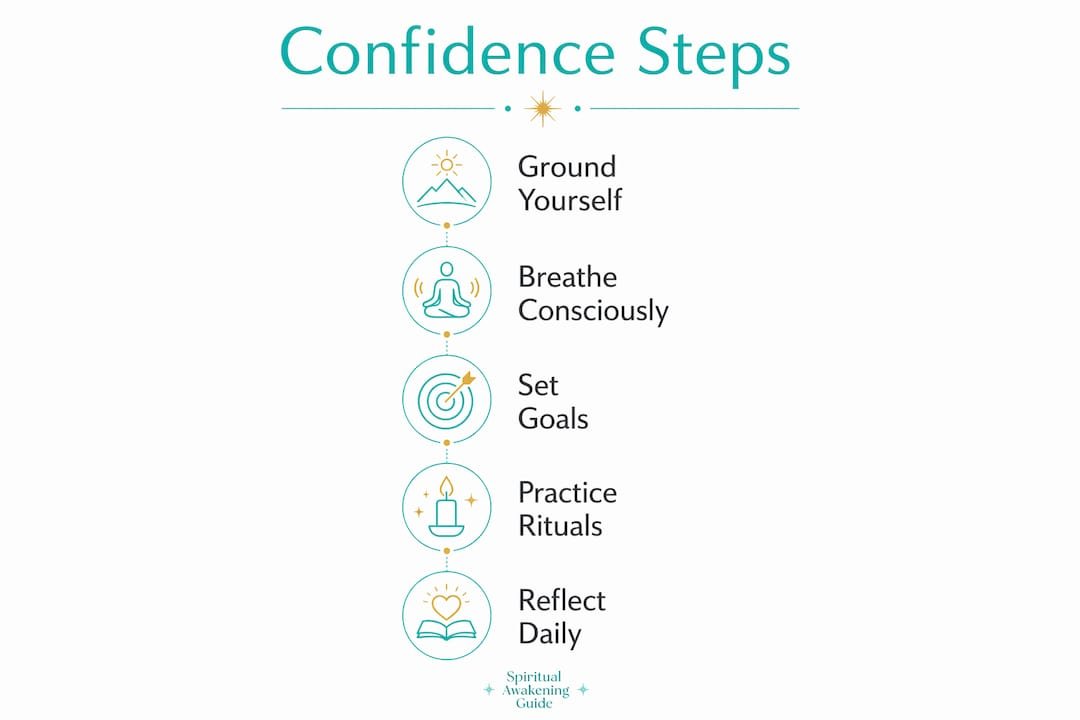
The Cleveland Clinic’s guidance on balanced confidence is the guardrail here: if you find yourself raising the bar the moment you meet a goal, that is a perfectionism signal. Pause, acknowledge the achievement, and hold the current level for one more week before stretching.
What to do when self-doubt arrives in the moment
Physiological arousal, a racing heart, shallow breathing, or a tight chest, is not a stop sign. Psychology Today identifies acting alongside that arousal as the defining habit of confident people. The following micro-ritual makes that possible.
Five-step grounding ritual for acute self-doubt:
- Stop moving. Plant your feet.
- Take one slow breath: four counts in, six counts out.
- Name the feeling aloud or in writing: “I feel nervous because this matters to me.”
- Identify the smallest possible next action, not the whole task.
- Take that action within 60 seconds.
When doubt arrives, run this quick checklist before deciding to withdraw:
- Is my body signaling danger or importance? (Usually importance.)
- Have I done a version of this before, even partially?
- What is the smallest step I can take right now?
- Am I comparing my internal state to someone else’s external appearance?
A micro-ritual addresses the immediate moment. It does not resolve the underlying pattern. If the same doubt recurs in the same context week after week, that is a signal to work at a deeper level, through journaling, inner-child dialogue, or professional support.
When to seek professional help and how to combine approaches
Spiritual practice and evidence-based therapy are not competing paths. They work best together. Seek professional mental-health support when you notice:
- Persistent hopelessness that does not lift after two or more weeks
- Functional impairment: difficulty maintaining work, relationships, or basic self-care
- Suicidal ideation or thoughts of self-harm
- Trauma responses (flashbacks, dissociation, hypervigilance) that intensify during inner-child or somatic work
When speaking with a therapist or coach about combining approaches, useful questions include: “Are you familiar with somatic or body-based practices?” “How do you approach spiritual frameworks in your work?” “Can we design a plan that includes both clinical and reflective practices?”
Spiritual work supports therapy by building self-awareness, daily structure, and a felt sense of safety. Therapy supports spiritual work by providing clinical containment for material that surfaces during deep inner-child or trauma-focused practices. Building emotional resilience is a practical complement to both. Self-compassion, treating mistakes as learning experiences rather than evidence of inadequacy, is the connective tissue between the two approaches.
A 4-week plan to build observable confidence
Durable confidence typically requires several months of consistent daily practice rather than a single breakthrough. This four-week plan builds the foundational habits.
| Week | Daily Focus | Weekly Reflection |
|---|---|---|
| Week 1 | Morning grounding (practice 1) + one micro-goal | List five positive traits; add one new trait |
| Week 2 | Add breathwork before one challenging moment | Review behavior log; note confidence-rating shifts |
| Week 3 | Add evening journaling (practice 4) + one small-action experiment | Identify one recurring doubt pattern |
| Week 4 | Add inner-child dialogue (practice 5) + ritual of reorientation | Full achievement review; set one monthly milestone |
Daily checklist format:
- Morning: two minutes of grounding or breathwork
- Midday: one micro-action or small-action experiment
- Evening: three-sentence journal entry + confidence rating (1–10)
At week 2, look for a consistent upward shift of 1–2 points in your morning confidence rating. At week 4, review whether your behavior log shows more attempts, not just better outcomes. Attempts are the metric that matters most at this stage.
For a social-confidence focus, weight practices 2, 3, and 6 more heavily and use the weekly stretch goal template. For a private inner-resilience focus, weight practices 4, 5, and 7 and use the daily micro-goal and positive-trait list. Daily spiritual practices from Spiritualmethod offer additional habit templates for both variants.
Recommended resources to continue the work
The sources and guides below represent a range of entry points depending on whether your focus is somatic, cognitive, or ritual-based.
- NHS self-esteem guidance (nhs.uk): Practical behavioral steps including the positive-trait list. Best starting point for readers who prefer a clinical, step-by-step frame.
- Psychology Today on confidence: Covers the arousal-and-action principle and social confidence development. Useful for understanding the mechanics before beginning practice.
- Cleveland Clinic on self-esteem: Addresses the balance between confidence and overconfidence. Helpful for readers prone to perfectionism.
- USF Counseling Center on self-confidence: Explains situational variation clearly. Use this if you are unsure which domain to target first.
- Spiritualmethod’s mind-body-soul connection guide: Integrates the theory and practices from this article into a broader healing framework.
- Spiritualmethod’s spiritual healing practices overview: A practical entry point for somatic and ritual-based work.
- Spiritualmethod’s inner child healing guide: The most direct resource for readers whose self-doubt has deep roots in early experience.
Confidence is not an innate, fixed characteristic. It is an ability that can be acquired and improved over time. Psychology Today frames this as both a practical and emotional skill: knowing you can handle the outcome of whatever you face, not knowing the outcome in advance.
Choose your starting resource based on where you feel the most resistance. Resistance usually marks the most productive entry point.
Key Takeaways
Durable self-confidence builds through consistent daily practice over 3–6 months, combining somatic, cognitive, and soul-level work rather than relying on any single technique.
| Point | Details |
|---|---|
| Confidence is situational | It varies by domain; target the specific context you want to change first. |
| Action updates confidence | The brain revises its capability estimate through evidence created by doing, not waiting. |
| Small goals produce evidence | Use daily micro-goals, weekly stretches, and a positive-trait list to accumulate proof of capability. |
| Arousal is a signal, not a stop | A racing heart means the situation matters; act within 60 seconds using the five-step ritual. |
| Spiritualmethod’s structured guides | The inner child healing and journaling guides offer the deepest next step for lasting inner change. |
Why inner healing changes confidence differently than posture hacks
Most confidence advice stops at the surface: stand taller, speak louder, fake it until you make it. Those adjustments have a real short-term effect, and the body-language research supports them. But they do not address the internal narrative that generates self-doubt in the first place.
The practices in this guide work at a different level. Journaling, inner-child dialogue, and ritual-based reorientation produce what somatic practitioners call “felt-sense evidence,” a body-level recognition that something has genuinely shifted. That kind of change tends to hold under pressure in a way that a posture adjustment alone does not.
The most overlooked aspect of confidence-building is patience with the timeline. Three to six months of consistent daily practice is not a long time in the context of a lifetime, but it feels long when you are in it. The readers who see the most durable results are those who treat the daily checklist as a non-negotiable practice rather than a motivational experiment.
Spiritualmethod’s 7-step inner peace guide is a natural companion to this work for anyone ready to go deeper.
Structured guides for readers ready to go deeper
Spiritualmethod offers a set of practical, structured guides for spiritual seekers who want to move beyond general advice and into a repeatable daily practice. Each guide maps directly to the practices covered in this article.
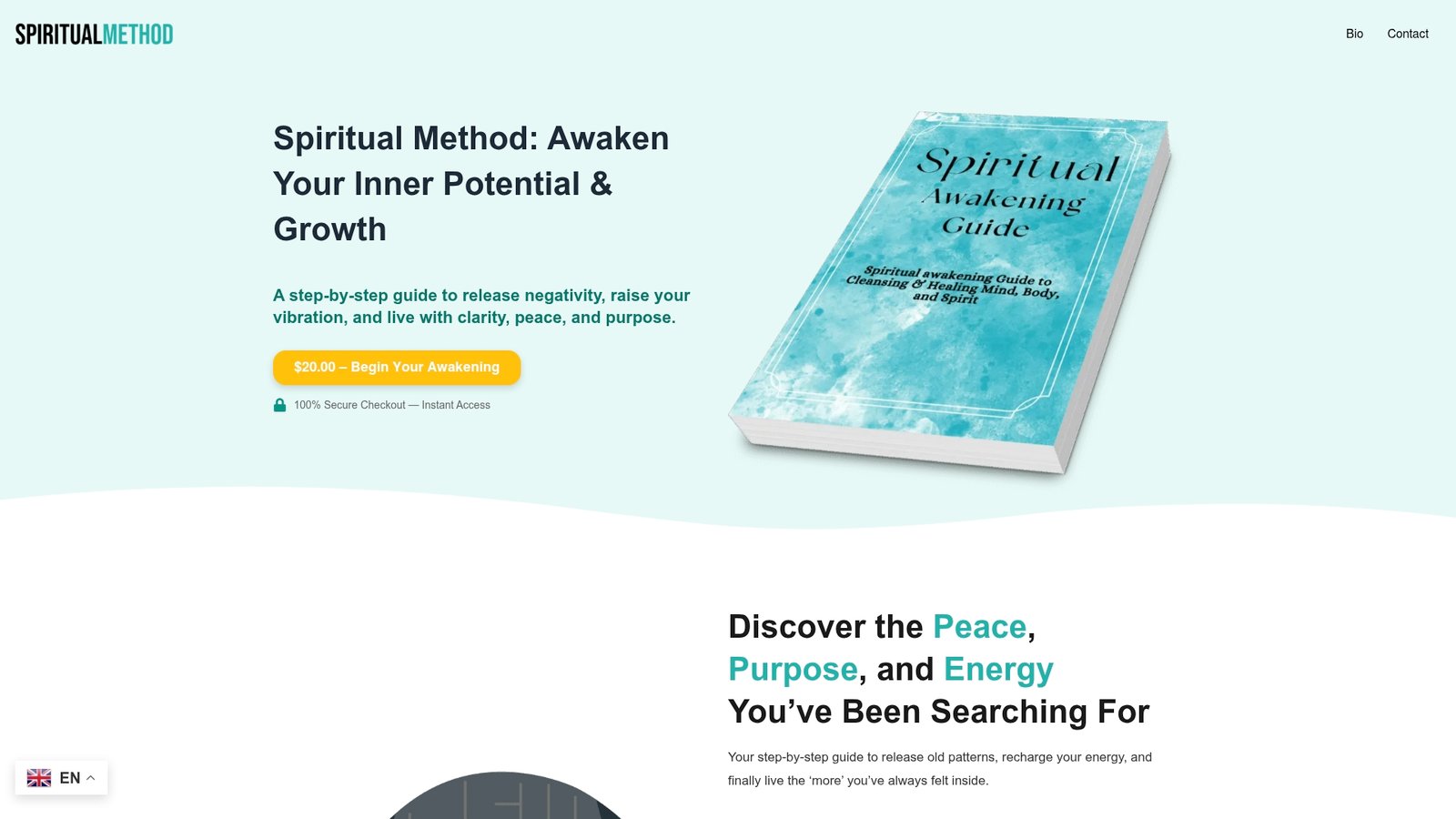
The inner child healing guide is the highest-priority resource for readers whose self-doubt feels rooted in early experience or shame. The journaling for soul healing guide provides structured prompts and templates that support the evening reflection practice in the four-week plan. The mind-body connection exercises guide covers the somatic and embodiment practices in detail, with step-by-step instructions suited to self-guided learning.
All three guides are available at Spiritualmethod.com. Visit the inner child healing guide to begin with the practice most directly tied to lasting confidence at the soul level.
This article is general information, not professional mental-health advice. Consult a qualified clinician for guidance specific to your situation.
Useful sources
The following sources informed this article’s claims and recommendations.
- NHS: Raising low self-esteem — Clinical behavioral guidance including the positive-trait list exercise and step-by-step self-help recommendations.
- Cleveland Clinic: How to improve self-esteem — Clinical perspective on balanced confidence and the risks of overconfidence and perfectionism.
- Psychology Today: The No. 1 habit all confident people have — Evidence for acting alongside physiological arousal as the defining habit of confident people.
- Psychology Today: Confidence basics — Overview of confidence as a learnable skill and its relationship to emotional strength.
- University of South Florida Counseling Center: What is self-confidence — Counseling-center guidance on situational variation in confidence and domain-specific practice design.
- Wikipedia: Confidence — Definitional grounding on self-confidence, self-esteem, and self-efficacy, including Bandura’s framework.
- Spiritualmethod: Inner child healing guide — Structured inner-child practices for addressing deep-rooted self-doubt.
- Spiritualmethod: Journaling for soul healing — Journal prompts and reflective-practice templates supporting the four-week routine.
- Somatic spiritual practices guide — Partner resource on the integration of somatic and narrative practices for felt-sense confidence change.
| Source | Type | Primary Use in Article |
|---|---|---|
| NHS | Clinical / government | Positive-trait list; behavioral self-help steps |
| Cleveland Clinic | Clinical | Balanced confidence; perfectionism warning |
| Psychology Today | Research / editorial | Arousal-and-action principle; confidence as learnable |
| USF Counseling Center | Academic / counseling | Situational confidence; domain-specific planning |
| Spiritualmethod guides | Practitioner / E-E-A-T | Inner-child, journaling, and somatic practice resources |