
Some days your spiritual life looks less like a glowing morning ritual and more like checking your phone in bed, rushing through coffee, and promising yourself you’ll “get back to it tomorrow.” That doesn’t mean you’re failing. It means you’re human, busy, and probably carrying more than others might realize.
Daily spiritual practices matter most in exactly those seasons. Not because they make life perfectly calm, but because they give you a way to return to yourself when life gets noisy. And you’re not alone in wanting that. About 70% of U.S. adults describe themselves as spiritual in some way, with many already engaging in inward-centering practices or meditation, according to Pew Research Center’s report on spirituality among Americans.
People often make the mistake of treating spirituality like a performance. They build a rigid routine, miss two days, feel guilty, and stop altogether. A grounded practice works better when it’s flexible enough to fit a strong day, a tired day, a grieving day, and an ordinary Tuesday.
Table of Contents
- The Foundation of Your Daily Spiritual Practice
- Crafting Your Morning Awakening Ritual
- Designing Your Evening Wind-Down Ritual
- Micro-Rituals for Grounding and Protection
- Aligning Your Practice with Moon Phases
- How to Stay Consistent and Inspired
The Foundation of Your Daily Spiritual Practice
The usual failure point is not lack of sincerity. It is friction.
A practice asks something from you at the exact moments life feels crowded. The baby is crying. Your phone is already buzzing. You slept badly. By the time you remember you wanted to pray, breathe, journal, or sit in silence, the day has already pulled you outward. That is why a daily spiritual practice has to fit your real life, not your fantasy life.
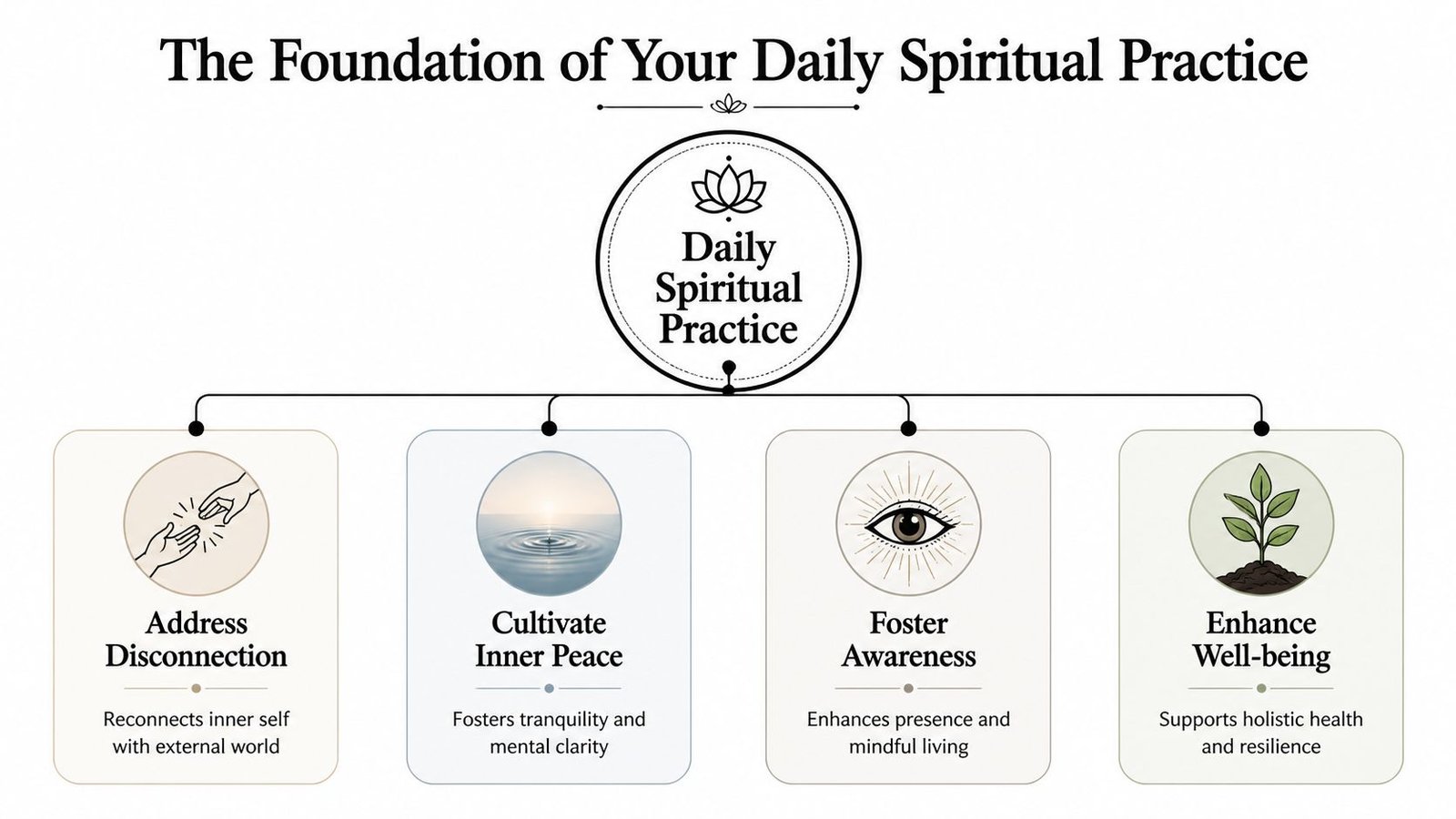
A good practice is repeatable before it is beautiful. Five honest minutes done regularly will carry you farther than a perfect routine you can only manage on peaceful weekends. If you have ever tried to raise your vibration with simple daily habits, you have probably felt that pattern already. Small repeated actions shape your inner state.
Three pillars that keep a practice alive
I come back to three pillars again and again because they hold up under pressure, even during busy seasons.
Intention
Intention gives the practice direction. Without it, spiritual habits can turn into motions you perform without feeling. Keep it plain and usable: “Help me stay steady today.” “Let me speak with care.” “Bring me back to myself.”Presence
Presence brings your full attention into a small moment. One conscious breath at the sink, one hand on the heart in the car, one minute of stillness before opening your laptop can be enough. Sincerity matters more than length.Reflection
Reflection helps you notice what is actually changing. You start to see which practices calm your nervous system, which ones feel forced, and which times of day make it easier to return to yourself. That is how a practice becomes personal instead of borrowed.
Daily spiritual practices help most when they feel like a return, not another item to manage.
What makes a practice sustainable
Sustainability comes from flexibility. A strong practice can expand on spacious days and shrink on hard ones without disappearing.
That means building tiers. Have a full version, a short version, and a one-minute version. Your full version might include prayer, journaling, breathwork, and a short walk. Your short version might be three breaths and one written intention. Your one-minute version might be standing still with your palm on your chest and saying, “I am here.”
This matters for one reason. People fall off track. Travel happens. Illness happens. Grief happens. Busy weeks happen. The goal is not to avoid every break. The goal is to know how to return without shame.
A sustainable practice also respects your natural rhythms. Some people meet themselves best at dawn. Others do not feel spiritually open until the house is quiet at night. Some need silence. Some settle through movement, singing, prayer, or writing. Use what helps you come back with honesty.
If a routine only works under ideal conditions, it is too fragile. Build one that can survive ordinary life.
Crafting Your Morning Awakening Ritual
Morning sets the tone. Not in a magical, all-or-nothing way, but in a practical one. The first few minutes of the day often decide whether you meet life from your center or from reactivity.
A national study using smartphone prompts found that people with more daily spiritual experiences reported lower depressive symptoms and higher overall well-being, and those experiences often occurred in the morning, according to this study in The International Journal for the Psychology of Religion. That doesn’t mean your morning routine has to be long. It means morning attention is worth protecting.

Build your ritual from a menu, not a rulebook
Rigid routines break when life changes. Menus adapt. Choose one practice from each category if you have time, or just one total if you don’t.
| Element | Try this | Why it helps |
|---|---|---|
| Breath | Take slow breaths for two minutes | Clears mental static and creates a transition into the day |
| Intention | Write one sentence beginning with “Today I choose…” | Gives your mind a direction to return to |
| Movement | Stretch, sway, or walk slowly around the room | Wakes up the body without forcing intensity |
| Attention | Drink tea or coffee without scrolling | Turns an ordinary habit into a grounding ritual |
The key is sequence. Wake, breathe, orient, move, then enter the world. When people skip all of that and go straight into messages, they usually spend the rest of the morning catching up to themselves.
Starter rule: Don’t build a ritual you can only do on your best day.
Two simple morning templates
Here’s a beginner version that fits a rushed schedule.
A 5-minute morning ritual
1 minute of slow breathing
1 minute with a hand on your chest, naming how you feel
1 minute setting an intention
1 minute of gentle stretching
1 minute drinking water, tea, or coffee in silence
That’s enough. It won’t impress anyone online, but it can change how you walk into a meeting, answer a text, or handle frustration.
When you have more room, use a fuller version.
First five minutes
Stay off your phone. Sit up, breathe deeply, and let your nervous system wake up before your notifications do.Next ten minutes
Journal with prompts like: “What do I need today?” “Where do I want to be led by wisdom instead of fear?” “What deserves my energy?”Final five minutes
Add movement, prayer, meditation, or a short reading that returns you to what matters.
If you like guided support, this can help you settle into the mood of practice:
What doesn’t work well is trying to copy someone else’s idealized routine exactly. If you hate long journaling, don’t force three pages. If silent meditation makes you agitated first thing in the morning, begin with movement or prayer instead. The point is awakening, not imitation.
Designing Your Evening Wind-Down Ritual
Morning asks, “How do I want to meet the day?” Evening asks a different question. “What am I ready to lay down?”
Many people carry the emotional residue of the day into the night without realizing it. Conversations replay. Unfinished tasks linger. The body may be home, but the mind is still in the office, in traffic, or in an old argument. An evening practice gives all of that somewhere to go.

Release is different from productivity
A common mistake is turning nighttime spirituality into one more self-improvement task. Evening isn’t for optimizing yourself. It’s for softening, clearing, and closing.
That might mean dimming lights, moving away from screens, or sitting in the same chair each night so your body begins to associate that spot with exhale and release. Sacred space doesn’t need to be dramatic. A corner with a candle, blanket, journal, or meaningful object is enough.
Try this short comparison:
| Morning energy | Evening energy |
|---|---|
| Direction | Release |
| Activation | Restoration |
| Choosing focus | Letting go of residue |
| Preparing to engage | Preparing to receive rest |
An evening menu that settles the nervous system
You don’t need to do every item. Pick one or two that match your state.
Brain dump journaling
Write down everything circling in your mind. Tasks, worries, half-finished thoughts, irritations. Don’t make it beautiful. The purpose is to stop carrying mental clutter in your body.Gratitude with specificity
Skip generic lists when you’re tired. Name three actual moments from the day. A kind text. A good meal. Five quiet minutes in the car before going inside.Energetic rinse
In the shower or while washing your hands, imagine the day leaving you. Not because you need to be perfect or “pure,” but because your system benefits from symbolic closure.Forgiveness prayer
Name what felt heavy. Ask for help releasing resentment, self-judgment, or disappointment. This can be very simple and still be profound.
Some nights, the most spiritual thing you can do is stop processing and let yourself rest.
If you want a gentle rhythm, use this sequence: write, give thanks, breathe, lights low, bed. Keep it simple enough that you’ll still do it after a hard day. Evening rituals fail when they become too ambitious for real fatigue.
What works is consistency in tone. You’re teaching your mind and body that the day has an end point. Over time, that repeated message can become a form of safety.
Micro-Rituals for Grounding and Protection
Long rituals are beautiful when you have the space. However, not everyone always has that space. They have meetings, commutes, caregiving, deadlines, crowded stores, and the sudden emotional weather that comes with being alive.
Micro-rituals are significant. Short, honest daily spiritual practices often hold better than elaborate ones because you can use them in real time. In recovery settings, daily spiritual practices such as meditation mediated success, accounting for 15% of the effect of meeting attendance on abstinence, according to this research on 12-step participation and spiritual practices. That principle travels well outside recovery. Brief, repeated practices can change how people respond to stress.

When you have one minute, use one minute
Here are a few real-life moments where tiny rituals work well.
Before a difficult meeting, plant both feet on the floor. Inhale slowly. Exhale longer than you inhaled. Then say inwardly, “I don’t need to absorb every energy in this room.”
After a stressful commute, pause before entering your home. Touch the door handle and decide what you are not bringing inside. Irritation. Hurry. Other people’s urgency.
In a crowded café, waiting room, or office, press your thumb to each fingertip one at a time. Let that small physical pattern anchor your attention in your own body instead of in the noise around you.
At your desk
Close your eyes for three breaths and relax your jaw. That tiny release often tells you how much tension you were carrying without noticing.In the bathroom at work
Run your hands under cool water and imagine your energy field resetting. Simple actions become rituals when attention is present.Before sleep when you’re too tired for a full practice
Place one hand on your heart and one on your belly. Whisper, “I’m here now.” That counts.
Protection without drama
Protection practices don’t need fear-based language. They work best when they come from steadiness, not panic.
A simple version is to visualize light around your body before entering a draining environment. Not as a wall against the world, but as a reminder that your energy has boundaries. Some people pair this with supportive tools and symbols. If that’s part of your path, this guide to crystals for healing and protection can offer ideas for what to keep on a desk, carry in a pocket, or place by the bed.
Your practice doesn’t become weak because it’s short. It becomes strong because you remember to use it.
Aligning Your Practice with Moon Phases
Some people want their daily spiritual practices to stay simple and earthbound. Others feel nourished by rhythm, symbolism, and natural cycles. Moon work can offer that without requiring complicated ritual language.
The most useful beginner approach is to focus on two moments only. The New Moon and the Full Moon. One supports direction. The other supports release.
A manifestation-oriented protocol linked consistent daily meditation and intention-setting with 70% to 80% of adherents reporting synchronized desire fulfillment within 3 to 6 months, and it notes that aligning practices with cycles such as moon phases can strengthen consistency and perceived efficacy, according to this description of the Law of Pure Potentiality protocol.
New Moon for direction
The New Moon works well for choosing what you want to cultivate. Not everything you want to fix. Just what you want to grow.
Try this short ritual:
- Sit in silence for a few minutes.
- Write down one to three intentions in clear language.
- Read them aloud slowly.
- End with a sentence of willingness such as, “I’m ready to cooperate with this unfolding.”
If you work with affirmations, keep them grounded. There’s a difference between fantasy and aligned language. Thoughtful wording matters. If you want inspiration for that side of practice, Your Word Is Your Wand is a strong reminder that language shapes attention, and attention shapes action.
Full Moon for release
The Full Moon is a good time to clear emotional buildup and notice what no longer fits.
You can keep the ritual very simple:
Write what you’re ready to release
Name habits, fears, resentments, or draining commitments.Acknowledge what has grown
Even small progress counts. More honesty. Better boundaries. A little more calm.Close with a physical act
Tear up the paper, place it aside, or wash your hands slowly after reading it.
Moon rituals work best when they support your daily life rather than replace it. If your day-to-day practice is unstable, moon work can become performance. If your daily rhythm is already alive, moon phases can add depth and meaning.
How to Stay Consistent and Inspired
Consistency is where most spiritual routines fall apart. Not because people don’t care, but because they expect devotion to feel inspired every day. It won’t.
A major gap in spiritual guidance is sustainability. Many resources talk about the value of daily engagement but offer little help for maintaining a practice, handling resistance, or starting again after a lapse, as noted in this discussion of the consistency challenge in daily spiritual practice. That gap matters because the primary work isn’t starting. It’s returning.
Stop chasing perfect streaks
The all-or-nothing mindset ruins more practices than lack of sincerity. People miss three days and decide the rhythm is broken. It isn’t broken. It’s waiting.
Here’s what holds up better over time:
Use a minimum practice
Define the smallest version that still counts. One breath prayer. Two lines in a journal. A moment of gratitude before sleep.Track return, not perfection
Instead of asking, “Did I do it every day?” ask, “How quickly did I come back when I drifted?”Match the practice to the season
A demanding week may call for micro-rituals. A quieter season may allow longer meditation, reading, or moon work.
Consistency isn’t doing the most. It’s refusing to disappear from your own life for too long.
A gentle reset after you fall off
When you’ve stopped for a while, don’t restart with guilt. Restart with honesty. Guilt makes practice feel like punishment. Honesty makes it feel like care.
Try this reset process:
- Name what interrupted the rhythm. Exhaustion, grief, travel, overcommitting, avoidance.
- Choose one practice for the next three days only.
- Attach it to something that already happens, such as morning tea or turning off the lamp.
- Reflect at the end of the week. Ask what felt supportive and what felt forced.
A weekly check-in can keep your practice alive without turning it into homework. Ask yourself:
| Reflection prompt | What to notice |
|---|---|
| When did I feel most connected this week? | The conditions that help you open |
| What part of the routine felt heavy or fake? | What needs simplifying or replacing |
| What tiny practice helped most? | What deserves to become a default habit |
Spiritual maturity rarely looks dramatic from the outside. It often looks like fewer abandoned mornings, quicker recovery after hard days, and a softer inner voice when you begin again. That’s real progress.
If you want a structured companion for building daily spiritual practices that can flex with real life, Spiritual Method offers a gentle step-by-step guide for grounding, intention-setting, energy protection, sacred bathing, and reflection. It’s especially helpful if you want practical tools, simple rituals, and support for returning to your practice without perfectionism.
Pingback: Daily Spiritual Practices for Inner Peace in 2026
Pingback: Left-Hand Path Discipline: A Practitioner's Guide to Self-Mastery