
Your body is tired, but your mind keeps pacing. One thought turns into ten. You replay a conversation, anticipate tomorrow, remember something from five years ago, then suddenly you’re trying to solve your entire life before sleep.
That state is exhausting because it doesn’t just live in the mind. It tightens the chest, shortens the breath, pulls you out of the present, and makes even simple moments feel noisy. If you’ve been trying to figure out how to calm an overactive mind, the answer usually isn’t one perfect trick. It’s a layered practice that meets you where you are.
Some moments call for immediate nervous system support. Some require steadier daily rituals. Some ask for a quieter room, a cleansed atmosphere, or a spiritual reset that helps your whole system feel safe again. Calm arrives faster when mind, body, and spirit are working together.
Table of Contents
- Why Your Mind Won't Stop and How to Reclaim Control
- Part 1 Immediate Relief for a Racing Mind
- Part 2 Building a Foundation of Calm with Daily Rituals
- Part 3 Clearing Your Energy for Deeper Peace
- Part 4 Troubleshooting and Staying Consistent
- Your Path to a Quieter Mind
Why Your Mind Won't Stop and How to Reclaim Control
An overactive mind usually isn’t a sign that you’re failing. It’s often a sign that your system has been asked to hold too much for too long. Stress, uncertainty, grief, overstimulation, unprocessed emotion, constant notifications, and lack of rest can all train the mind to stay on guard.
That helps explain why so many people seek contemplative tools for relief. In the United States, 9.3 million adults have used meditation in the past 12 months, and mental health problems were identified as the most important reason for meditation use, according to this review on meditation and mindfulness use. The same review noted that a 2019 review of mindfulness-based interventions found no apparent negative effects and concluded their general health benefits justify their use as adjunctive therapy for patients with anxiety disorders.
That matters because it takes shame out of the equation. You are not the only one trying to quiet a mind that won’t settle.
Practical rule: Stop treating mental overactivity as a character flaw. Treat it as a signal that your inner environment needs support.
A calmer mind usually comes from four kinds of care working together:
- Immediate regulation: tools that interrupt spiraling in the moment
- Daily ritual: habits that lower baseline stress before you boil over
- Energy clearing: practices that help your body and space feel lighter
- Consistency and repair: gentle ways to stay with the work when life gets messy
If you only use calming tools in emergencies, relief can feel temporary. If you only lean on spiritual practices without tending the nervous system, you may feel inspired for a moment but still end up flooded. Real steadiness grows when practical tools and sacred practices support each other.
Part 1 Immediate Relief for a Racing Mind
When the mind is racing, long explanations don’t help. You need something simple enough to do while anxious and reliable enough to interrupt the loop.
Use 4-7-8 breathing when thoughts are sprinting
The 4-7-8 breathing technique is one of the fastest tools for bringing the body down from mental overdrive. It involves inhaling for 4 seconds, holding for 7, and exhaling for 8. According to this breakdown of the 4-7-8 method, it reduces racing thoughts in 78% of users immediately, is associated with a 40 to 50% drop in cortisol, and increases vagal tone by 20 to 30% after a session.
Here’s how to do it:
- Get supported: Sit upright or lie down. Place one hand on your belly and one on your chest.
- Inhale for 4: Breathe in through your nose. Let the belly expand first.
- Hold for 7: Don’t clamp down. Let the pause feel steady, not strained.
- Exhale for 8: Purse the lips and breathe out slowly through the mouth.
- Repeat 4 cycles: Keep the exhale longer than the inhale.
The common mistake is shallow chest breathing. If your shoulders lift more than your abdomen, slow down and restart. The point isn’t to perform the count perfectly. The point is to lengthen the exhale enough that the body begins to believe the danger has passed.
If your thoughts are loud, don’t argue with them first. Regulate the body, then assess the mind.
Ground the mind through the senses
Breathwork is powerful, but sometimes the mind keeps floating upward. In those moments, grounding through the senses works better because it pulls attention out of abstraction and back into the room you’re in.
Try the 5-4-3-2-1 grounding practice:
- 5 things you can see: Name objects slowly. Notice color, shape, and distance.
- 4 things you can feel: Your feet on the floor, fabric on your skin, the chair under you.
- 3 things you can hear: A fan, birds outside, distant traffic, your own breath.
- 2 things you can smell: Tea, soap, air, a candle, or “neutral room.”
- 1 thing you can taste: Water, mint, or the natural taste in your mouth.
This works well when the mind is forecasting disaster or replaying old scenes. Sensory detail reminds the nervous system that you’re here, now, not trapped in imagination.
Here’s when I’d choose grounding over meditation: when someone is too activated to sit still comfortably. Meditation can feel spacious when you’re regulated, but when you’re spiraling, sensory contact is often the kinder doorway.
| Technique | Best For | Time Commitment |
|---|---|---|
| 4-7-8 breathing | Sudden spikes of anxiety, bedtime overthinking, physical agitation | 2 to 5 minutes |
| 5-4-3-2-1 grounding | Rumination, panic spirals, feeling disconnected from the present | 1 to 3 minutes |
| Thought labeling | Repetitive mental loops, self-criticism, worry stories | Under 1 minute to start |
Label the thought instead of becoming it
A thought feels powerful when it arrives as truth. It weakens when you recognize it as a mental event.
Try thought labeling in plain language:
- “This is catastrophizing.”
- “This is the fear voice.”
- “This is future-tripping.”
- “I’m having the thought that I’m not safe.”
That small shift creates distance. You’re no longer inside the thought. You’re observing it.
Don’t fight the thought. Don’t try to prove it wrong on the spot. Just name it neutrally, then return to breath or grounding. This is what works. Harsh self-correction usually backfires because it adds a second wave of tension on top of the first.
A good sequence in an acute moment looks like this:
- 4-7-8 breathing
- 5-4-3-2-1 grounding
- Thought labeling
- A simple closing phrase such as, “I can come back to this later”
That last sentence matters. An overactive mind often believes it must solve everything immediately. It doesn’t.
Part 2 Building a Foundation of Calm with Daily Rituals
A racing mind settles faster when calm is already part of the architecture of your day. If you only reach for support after you’re overwhelmed, you stay in a cycle of recovery without prevention.
Mindfulness practices become more persuasive when you look at their long arc, not just the immediate soothing effect. Mindfulness-based stress reduction has been found to be noninferior to escitalopram, a common first-line medication for anxiety disorders, and research shows meditation influences stress pathways in the brain and changes structures related to attention and emotion regulation. A 2019 review also found positive effects on depression lasting 6 months or more, as described in this NCCIH overview of mind and body approaches for stress.
That doesn’t mean every person needs a long meditation practice. It means small, repeated acts of regulation change the way you live inside your mind.
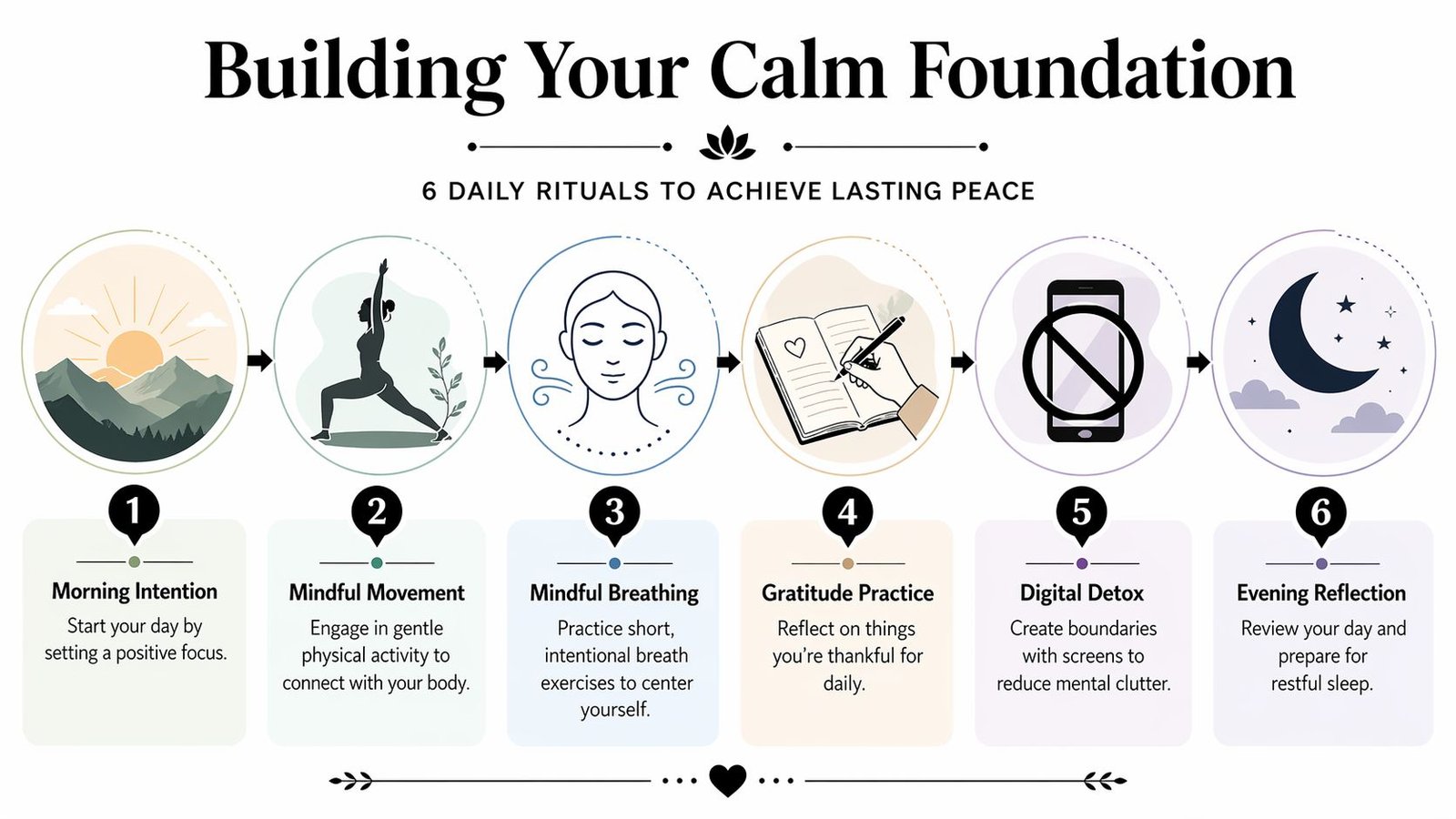
A morning rhythm that protects your attention
The first moments of the day are sacred because the mind is still impressionable. If the phone enters first, other people’s urgency becomes your atmosphere.
A steadier morning routine can be simple:
- Wake before input: Don’t check messages immediately. Give yourself a few quiet minutes first.
- Set one intention: Choose a phrase such as “Today I move gently” or “I return to my center.”
- Move lightly: Stretch, walk, or practice a few minutes of yoga.
- Breathe on purpose: Take a few slow cycles before coffee, news, or work.
- Write a brief page: Empty the mental clutter before it hardens into tension.
This kind of rhythm doesn’t need to be long. It needs to be repeatable. People often fail at routines because they design them for their ideal self instead of their real life.
If you’re also doing deeper spiritual work, practices that help you raise your vibration through grounded daily habits can fit naturally here, especially when the focus stays on steadiness rather than perfection.
An evening ritual that tells the body the day is done
Many people try to sleep with a nervous system that still thinks it’s working. The body needs a closing signal.
Try this evening pattern:
- Dim the pace: Lower lights or reduce stimulating input.
- Do a brain dump: Write down unfinished tasks, worries, or looping thoughts.
- Name three points of gratitude: Keep them concrete. Warm tea counts. A kind message counts.
- Take gentle movement or stillness: A stretch on the floor, a seated breath practice, or quiet music.
- Create a boundary with screens: Let your mind stop absorbing before bed.
The evening ritual isn’t about becoming spiritually impressive. It’s about helping the body trust that rest is allowed.
Why small daily practices work better than emotional heroics
People often wait until they’re falling apart to care for themselves. That pattern keeps calm feeling dramatic and rare.
Daily rituals work better because they lower friction. They create familiarity. They teach the nervous system what safety feels like before a hard day arrives.
A few rituals that work well in combination:
- Mindful movement: Choose gentle consistency over intensity. Walking, stretching, or yoga reconnects attention to the body.
- Short breath practice: A few minutes done every day trains access, not just theory.
- Journaling: Use one page for mental clutter and one line for gratitude.
- Digital limits: Not every thought needs a screen attached to it.
- Micro-pauses: Stand at a window, place a hand on the heart, or drink water without multitasking.
You don’t need a flawless routine. You need a rhythm that tells your mind, every day, “You don’t have to stay in survival mode.”
Part 3 Clearing Your Energy for Deeper Peace
Sometimes the mind keeps spinning because the atmosphere around you is chaotic. The room is cluttered. The air feels stale. Your body is carrying the emotional residue of the day. In those moments, practical mental tools help, but spiritual cleansing can reach a different layer.

Clean the room and the mind follows
Smudging works best when you treat it as intentional clearing, not performance. Sage or palo santo can mark a transition. You are telling your space, “What’s heavy can leave now.”
A simple smudging practice:
- Open a window first: Give the energy somewhere to go.
- Light the bundle or stick carefully: Let it smoke, not blaze.
- Move slowly through the room: Corners, doorways, bed area, desk, and entry points matter.
- Speak an intention aloud: “Only peace may remain here.” Keep it simple and honest.
- Close with stillness: Don’t rush back into noise.
What doesn’t work is waving smoke around while mentally staying frantic. The power is in the combination of breath, attention, and intention.
If smoke cleansing isn’t practical, sound can do similar symbolic work. A bell, soft chime, prayer, or even clapping through the corners of a room can shift the feeling of a space.
Work with crystals as anchors, not magic shortcuts
Crystals can be grounding when used as tactile reminders of the state you’re cultivating. They’re most helpful when you stop expecting them to do the work for you and start using them as partners in attention.
A few approachable choices:
- Black tourmaline: Useful for grounding and energetic protection
- Amethyst: Often chosen for calm, rest, and spiritual quiet
- Clear quartz: Helpful when you want clarity and focused intention
- Rose quartz: Supportive when the mind is harsh and the heart needs gentleness
Use them. Hold one during breathwork. Keep one near your bed. Place one on your desk before a difficult conversation. If you want a fuller guide to choosing and using stones, this resource on crystals for healing and protection can help you build a more personal practice.
A crystal is most effective when it becomes a cue. Touch the stone, soften the jaw, lengthen the exhale, return to yourself.
Here’s a calming visual practice you can pair with your crystal ritual:
Create a sacred bath that helps you release the day
A bath can become more than hygiene. It can become a ceremony of release.
Build it with a few elements:
- Salt: Add bath salts to symbolize cleansing and softening.
- Herbs or soothing botanicals: Choose scents that signal comfort.
- Low light: Candlelight or soft lighting changes the nervous system’s message.
- An intention: “I release what isn’t mine.” “I return to peace.” “I let this day end.”
- A closing action: Drain the tub slowly and visualize tension leaving with the water.
If you don’t have a bathtub, a shower can carry the same meaning. Let the water be your reset. Place your hands on the heart and belly. Imagine the day washing off in layers.
Moon-aligned bathing rituals can add depth for people who feel connected to cyclical practice. The important part isn’t complexity. It’s reverence. When you create even ten minutes of sacred attention, the mind often quiets because the spirit finally feels heard.
Part 4 Troubleshooting and Staying Consistent
The usual assumption is that if a calming tool works, it should work every time in the same way. That’s not how healing goes. Some days breathwork helps immediately. Some days the body needs touch, tears, movement, or rest before the mind will soften.
When breathwork isn’t enough
If thoughts remain intrusive or the body feels locked in alarm, Havening Touch can be a gentler next step. According to this explanation of Havening Touch and thought labeling, the technique can produce an 85% immediate reduction in anxiety by using bilateral touch with neutral thought labels, and it’s associated with lowering cortisol by 27 to 30% per session.
The practice is simple:
- Name the thought neutrally: “This is fear.” “This is overthinking.”
- Stroke the upper arms from shoulder to elbow or use a gentle face-washing motion.
- Keep your voice kind: Add a phrase like, “I am safe enough to soften.”
- Continue for a few minutes: Let the repetition settle the body.

This works especially well for people who get more activated when they try to “think positively.” Touch can reach the nervous system when words cannot.
Consistency grows from observation, not pressure
People stay consistent when they can see patterns. They quit when they only measure perfection.
Use a very simple tracker:
- Mood before practice: restless, flat, overwhelmed, steady
- What you used: breathwork, grounding, journaling, bath, smudging
- How it felt after: lighter, unchanged, sleepy, clear, emotional
- Notes: time of day, triggers, what helped most
Within a short time, you’ll start noticing your own map. Maybe evenings need less screen time. Maybe mornings improve with movement. Maybe certain spiritual rituals work best after grounding first.
If you want to strengthen the inner steadiness that makes routines easier to hold, practices that support emotional resilience can help you stay with yourself when old patterns return.
Don’t use spirituality to silence real feelings
This part matters. Spiritual practice should help you process emotion, not skip over it.
If you light a candle, say affirmations, and force gratitude while grief, anger, or fear is asking to be felt, the mind may get louder, not quieter. That isn’t failure. It’s feedback.
Try this instead:
- Acknowledge what’s real: “I’m anxious.” “I’m hurt.” “I’m grieving.”
- Use the practice to support the feeling: breathe with it, journal with it, bathe with it
- Release the need to feel better instantly: calm is often gradual
- Reach for outside support when needed: some burdens need witness, not just ritual
Peace doesn’t come from pretending difficult emotions aren’t there. It comes from meeting them without abandoning yourself.
Your Path to a Quieter Mind
A quieter mind rarely arrives through force. It grows through relationship. You learn how to soothe the body in the moment, how to shape your days so they hold less chaos, and how to clear the emotional and energetic residue that keeps your inner world crowded.
That’s why the deepest answer to how to calm an overactive mind is holistic. Use immediate tools when thoughts are racing. Build rituals that create steadiness before overwhelm hits. Cleanse your space and energy when life feels heavy. Stay honest when the path gets uneven.
Some practices will work quickly. Others will become meaningful because they work slowly and repeatedly. Both kinds matter.
You do not need to become thoughtless. You do not need to be peaceful all the time. You only need to become more skillful at returning. Each breath, each boundary, each journal page, each candle, each prayer, each grounded choice teaches your system that calm is possible.
With time, the mind stops feeling like an enemy. It starts feeling like something you can listen to, guide, and soften.
If you want a guided way to turn these practices into a steady spiritual routine, Spiritual Method offers a step-by-step path for releasing negativity, building sacred rituals, protecting your energy, and creating more clarity, peace, and purpose in daily life.
Pingback: How to Set Intentions for the Day: A Morning Ritual – Spiritual awakening guide
Pingback: How to Reduce Stress and Anxiety Naturally: A Simple Guide - Spiritual awakening guide