
The forgiveness journal prompts that work best combine three approaches: benefit-finding, the Four Rs sequence, and compassionate-letter writing. Research links these formats to measurable reductions in bitterness and clearer next steps, whether that means repairing a relationship or releasing it. Pick one set below, write for 10 to 20 minutes, and repeat the practice on a regular schedule to see the shift.
TL;DR:
- Writing about benefits and personal growth helps move beyond rumination and deepens forgiveness, especially when following the Four Rs sequence.
- Clarifying facts, feelings, and benefits in structured prompts prevents shallow affirmations and ensures accountability and progress.
- Delaying journaling about betrayal or trauma by a few days improves clarity and reduces reactivity, supporting healthier reconciliation decisions.
- Combining journaling with grounding, rituals, or therapy enhances safety, prevents overload, and fosters lasting emotional recovery.
- A repeatable system with guided prompts, habit trackers, and ritual routines increases consistency and deepens forgiveness work over time.
Table of Contents
- Why journaling helps with forgiveness
- Prompts for forgiving others
- Prompts for forgiving yourself, mapped to the Four Rs
- Prompts for processing betrayal and rebuilding trust
- How to use these prompts safely and effectively
- How Spiritual Method and Sean structure forgiveness journaling
- Setting up a mindset and space that support the work
- Common obstacles and how to work through them
- The psychology behind forgiveness journaling
- Combining journaling with meditation and therapy
- A note on nonlinear progress
- A structured guide for readers ready to go deeper
- Sources
- FAQ
Why journaling helps with forgiveness
Structured writing gives the brain a way to process a hurtful event instead of replaying it. A randomized study of 304 participants found that writing about the benefits of an interpersonal transgression facilitated forgiveness more than writing about the traumatic details or an unrelated topic. The benefit-finding condition moved people toward cooler, meaning-focused appraisal rather than hot, ruminative replay.
That same logic explains why the Four Rs model, responsibility, remorse, restoration, and renewal, works better as a sequence than as a grab bag of questions. Skipping straight to renewal without naming what happened tends to produce hollow affirmations instead of real change.
- Benefit-finding prompts shift focus from injury to meaning and growth.
- The Four Rs sequence prevents shortcuts that leave accountability unfinished.
- Unstructured writing about pain alone can deepen rumination instead of resolving it.
Writing about the benefits of a transgression increased forgiveness in a controlled study, compared with writing only about the hurt itself. That finding is the basis for why benefit-finding prompts lead the lists below.
Prompts for forgiving others
A good session moves through five stages: name the facts, sit with the feelings, find the benefit, consider the other person’s perspective, then write a commitment. Working through them in order, rather than jumping to forgiveness, keeps the exercise honest.
- Describe what happened in plain, factual language, without judgment words.
- Write down exactly what you lost or what changed because of it.
- Name the feeling underneath the anger. Is it grief, fear, or embarrassment?
- What did this experience teach you about your own limits or values?
- Is there any skill, boundary, or insight you gained because of what happened?
- If you had to find one unexpected benefit, however small, what would it be?
- What might this person have been dealing with that you did not see at the time?
- Were they acting from fear, ignorance, or their own pain? Does that change anything for you?
- What would it look like to hold them accountable and still let go of resentment?
- Do you want reconciliation, distance, or something in between?
- Write one sentence describing the boundary you need going forward.
- What would you say to this person if you knew they could truly hear you?
- What does forgiving them free you from carrying?
- How will you know, a month from now, that this forgiveness has held?
Pro Tip: If a prompt makes you angrier instead of clearer, skip ahead to a benefit-finding question and come back to the harder one later.
Prompts for forgiving yourself, mapped to the Four Rs
The Four Rs of self-forgiveness, responsibility, remorse, restoration, and renewal, give self-forgiveness journaling a shape that a single “just let it go” prompt cannot. Moving through each phase in order supports more lasting recovery than skipping to the end.
Responsibility
- Describe exactly what you did, in specific and factual terms.
- What was within your control, and what was not?
Remorse
- What do you feel now when you think about this? Let the feeling be there without editing it.
- Is there a difference between guilt over the act and shame about who you are?
Restoration
- What is one concrete action that would repair the harm, even partially?
- Have you already taken steps to make things right? What is left undone?
Renewal
- What would you say to a friend who made the same mistake?
- What has this mistake taught you that you will carry forward?
- How will you track whether you are actually changing, not just feeling sorry?
Pro Tip: Do not move to renewal prompts until you have written at least one honest restoration step, even if you cannot act on it yet.
Self-forgiveness is not just an emotional nicety. A meta-analysis in the Journal of Counseling Psychology found that self-forgiveness correlates moderately with psychological well-being and physical health outcomes, which is part of why therapists build entire sessions around it.
Prompts for processing betrayal and rebuilding trust
Betrayal, infidelity, a broken confidence, a serious breach of trust, needs a different structure than everyday hurt. Safety decisions and forgiveness decisions are not the same question, and conflating them tends to trap people in relationships they should leave or keep them from repairing ones worth saving.
- Write a timeline of what happened, including what you knew and when.
- List the objective signs, not promises, that would show real change: actions, not words.
- Separate two questions on the page: “Am I safe here?” and “Do I want to forgive this?”
- What boundary would need to hold no matter what you decide about forgiveness?
- What has this person actually done differently in the past month?
- If a friend described this same situation to you, what would you tell them?
- What would trust-building look like in concrete, checkable steps over the next 90 days?
- Is your hesitation about them, or about your own fear of being hurt again?
- What does releasing this look like if reconciliation is not the goal?
How to use these prompts safely and effectively
A session works best in three stages: a short grounding period, focused writing, and a closing reflection. This mirrors the sequence practitioners recommend for reducing re-traumatization while still making progress.
- Ground yourself for 3 to 5 minutes with slow breathing or a short walk before you write.
- Write for 10 to 20 minutes on a single prompt set without switching topics halfway through.
- Close with 2 to 5 minutes of reflection: what shifted, what stayed the same.
- Use a daily micro-practice of one prompt when a full session is not realistic.
- Pause and consider professional support if writing repeatedly increases distress rather than easing it.
Structured writing that scaffolds facts, then benefit-finding or responsibility, then an action plan, then a grounded close, is associated with lower re-traumatization and stronger behavior change than open-ended writing, according to guidance summarized in Psyche’s guide to self-forgiveness. If a prompt sends you into obsessive replaying rather than clarity, that is a signal to switch formats or talk to a therapist rather than push through.
How Spiritual Method and Sean structure forgiveness journaling
This approach builds forgiveness work into ritual-friendly routines rather than one-off worksheets. The approach pairs written prompts with small physical rituals, so the reflection has a beginning and an end instead of trailing off unfinished.
- A compassionate-letter template that walks you through writing to yourself from a supportive perspective.
- A habit tracker designed to record forgiveness practice without turning missed days into another source of guilt.
- Ritual steps, grounding, journaling, closing, adapted from the forgiveness ritual guide for readers who want structure around the writing itself.
Sean’s other notes on journaling for soul healing cover related formats for readers who want to expand beyond forgiveness-specific prompts.
Setting up a mindset and space that support the work
The environment you write in shapes how honest you can be on the page. A quiet space, even ten minutes at a kitchen table before the house wakes up, tends to produce more useful writing than a rushed session between meetings.
Before you start, name your intention for the session out loud or in one written line: repair, clarity, or release. That single sentence keeps the prompts from turning into a spiral of unfocused venting. Keep your phone out of reach; notifications during a forgiveness session pull you out of the reflective state the prompts are designed to build.
Some people find it helps to light a candle or hold an object connected to calm before writing, not because the object does the work, but because the small ritual signals to your mind that this time is set apart. Others prefer nothing more than a closed door and a specific notebook reserved only for this practice. Either approach works if it is consistent.
Give yourself permission to write badly. Forgiveness journaling is not an essay. Sentences can be incomplete, contradictory, or messy, and that roughness is often where the real material shows up.
Common obstacles and how to work through them
The most frequent obstacle is confusing forgiveness with approval. Writing “I forgive them” while still believing what they did was fine, or feeling like you have to believe that, stalls the process before it starts. Reframing the prompts around release rather than excusal usually breaks that logjam.
A second obstacle is rushing the Four Rs. Readers often want to skip from responsibility straight to renewal, hoping the good feeling arrives faster. Restoration questions get left blank, and the practice feels incomplete because it is.
A third obstacle is rumination disguised as reflection. If the same three sentences keep appearing session after session with no new angle, the writing has stopped processing and started looping. Switching to a compassionate-letter format, imagining an unconditionally compassionate friend and writing from their perspective, often unlocks material that direct prompts cannot reach.

A fourth obstacle is timing. Journaling about a betrayal the same day it happened rarely produces clarity, since the nervous system is still in a reactive state. Waiting a few days, while still journaling about feelings in a lighter, factual way, tends to produce sharper insight once the deeper prompts arrive.
Finally, some readers stall because a single prompt feels too heavy to answer honestly. There is no rule that says every prompt gets a full answer. Writing one true sentence and moving on beats a paragraph of avoidance.
The psychology behind forgiveness journaling
Several frameworks inform the prompts in this article. Worthington’s REACH model and Enright’s process model are two of the most widely cited approaches used to organize forgiveness work in both clinical and self-guided settings, and they overlap with the Four Rs sequence used above.
Underneath these models sits a simpler mechanism: cognitive reappraisal. Forgiveness work asks a person to hold the same facts while changing the meaning attached to them, which is why benefit-finding prompts carry more evidence behind them than prompts that only ask someone to relive the hurt.
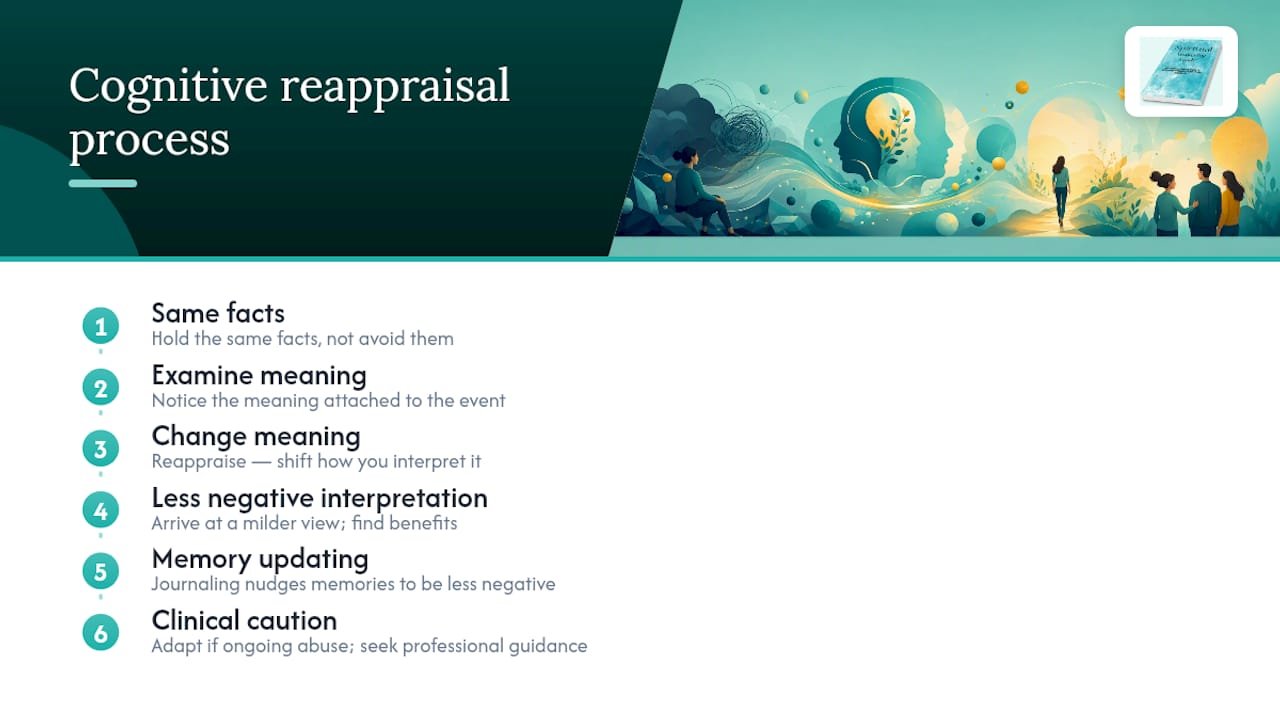
There is also a memory component. Research using neuroimaging has found that forgiveness can update interpersonal memories to be less negative, with activity in regions including the dorsomedial prefrontal cortex and posterior hippocampus tracking that shift. Journaling appears to be one practical way to nudge that updating process along, since it forces repeated, structured engagement with the memory rather than avoidance of it.
Clinical literature also carries a caution worth naming directly: self-forgiveness interventions may need adaptation for people dealing with ongoing abuse or recent trauma, and professional guidance matters more than a worksheet in those cases.
Combining journaling with meditation and therapy
Journaling works best as one part of a larger practice rather than the whole plan. A short meditation or grounding period before writing settles the nervous system enough that the prompts land as reflection instead of triggering another wave of reactivity. Even three slow breaths before opening the notebook changes the tone of what gets written.
For deeper ruptures, betrayal, family estrangement, long-standing resentment, journaling pairs well with therapy rather than replacing it. A therapist can hold the parts of the story that feel too large for a page and help sort safety decisions from forgiveness decisions in real time. Bring journal entries into sessions if useful; many therapists welcome the material as a starting point for conversation.
For lighter, everyday friction, the spiritual awakening guide’s reflection routines offer a way to fold forgiveness prompts into an existing daily or weekly practice rather than treating it as a separate project. Consistency across formats, meditation, prompts, occasional therapy check-ins, tends to matter more than which single method gets the most credit.
A note on nonlinear progress
Forgiveness rarely moves in a straight line. You will answer a prompt fully one week and feel the same old anger resurface the next, and that is not failure, it is the normal shape of this work. Try this: sit for one minute of quiet breathing, then answer a single benefit-finding prompt. Adapt the language to whatever belief system fits you; the structure matters more than the wording.
— Sean
A structured guide for readers ready to go deeper
Free prompts get you started, but a structured format helps the practice stick once the first session ends. A downloadable guide builds forgiveness and inner healing work into a format designed to be used repeatedly, not read once and set aside.

- A compassionate-letter template ready to fill in during harder sessions.
- A forgiving habit tracker that records practice without punishing missed days.
- Grounding and sacred bathing rituals to open and close a journaling session.
- Intention-setting pages that connect journaling to broader spiritual growth work.
The guide fits readers who have tried a few prompts here and want a repeatable system rather than starting from a blank page each time. Visit the spiritual awakening guide downloads to get the full 50-plus page ebook, planner, and moon manifesting ritual guide for $20.
Sources
- Writing about the benefits of an interpersonal transgression facilitates forgiveness — McCullough et al.
- How to forgive yourself and move past a hurtful mistake — Psyche
- Forgiving the self and physical and mental health correlates: A meta-analytic review — Journal of Counseling Psychology
FAQ
What are the 4 R’s of self-forgiveness?
The Four Rs are responsibility, remorse, restoration, and renewal, a sequence for working through a personal mistake. Moving through them in order, rather than skipping to renewal, supports more lasting emotional recovery.
What is the 3/2/1 method of journaling?
The 3/2/1 method has you write from three perspectives: your own view, the view of the other person involved, and a neutral or compassionate observer’s view. It is often used alongside forgiveness prompts to build empathy and cognitive distance from a hurtful event.
What are the 4 R’s of forgiveness?
When applied to forgiving others rather than yourself, the same responsibility, remorse, restoration, and renewal framework is often adapted to ask what happened, how you feel, what repair looks like, and how the relationship or boundary moves forward. The exact wording varies by practitioner, but the sequence stays consistent.
Who is the hardest person to forgive?
Many people find self-forgiveness harder than forgiving others, since it requires holding both accountability and compassion for the same person: yourself. Self-forgiveness correlates with better psychological and physical well-being, which is part of why it gets particular attention in journaling and therapy alike.