
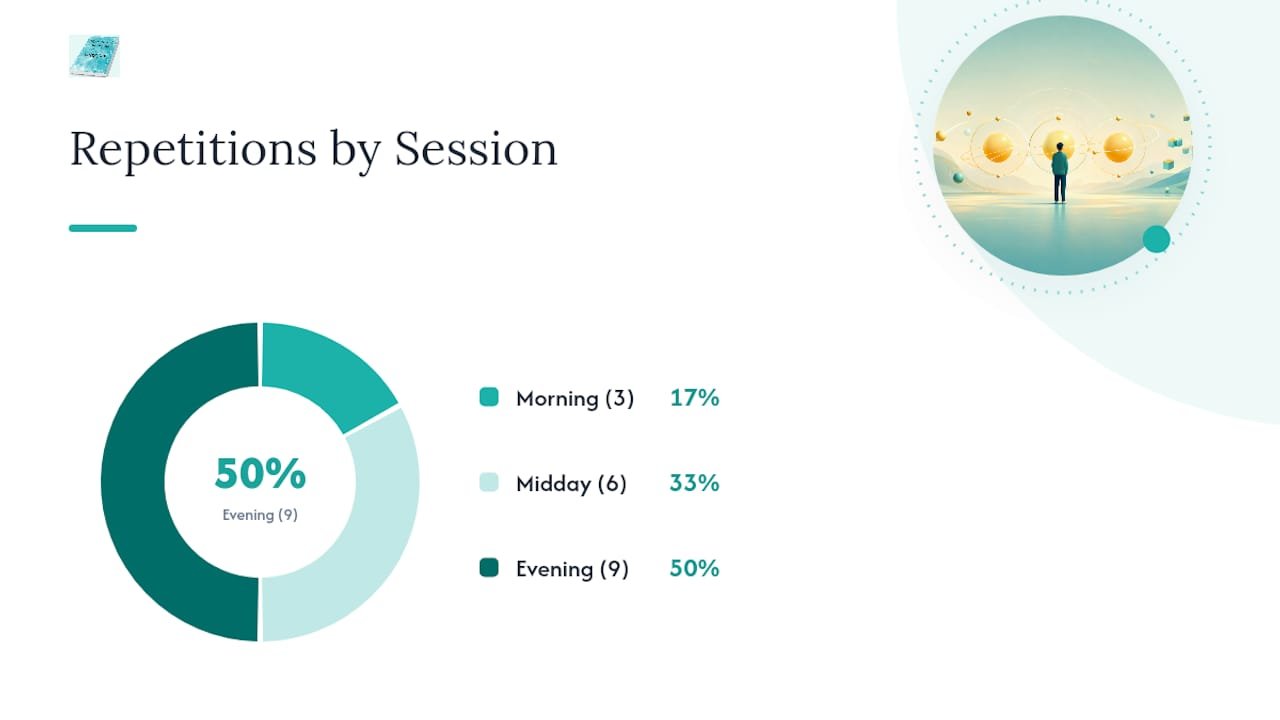
The 369 manifestation method is a simple journaling routine: write one present-tense affirmation 3 times in the morning, 6 times at midday, and 9 times before bed, every day, for a chosen stretch of time. Most people run it for several weeks or a month or more. Handwriting is preferred over typing, and the entire structure hinges on one rule: a single affirmation per cycle, not a wish list.
TL;DR:
- The 369 method is most effective when limiting affirmations to a single, specific, believable, present-tense focus tailored to the goal.
- Practitioners typically see internal changes like increased confidence within two to three weeks, with external results often appearing after longer cycles.
- Consistency relies heavily on pairing journaling with physical cues, daily action, and structured tracking, preferably through handwriting.
- Skipping days, using vague affirmations, or failing to act on intentions can stall progress and reduce the method’s effectiveness.
- The recommended practice duration is generally three to six weeks, depending on the goal’s complexity, with longer cycles suited for bigger ambitions.
Table of Contents
- How to Structure Your Morning, Midday, and Evening Sessions
- Writing an Affirmation That Actually Works
- How Long Should You Practice, and What Changes First
- Why It Might Feel Like Nothing Is Happening
- Pairing 369 With Visualization and One Daily Action
- Where the Structure Behind This Practice Comes From
- When 369 Actually Helps and When It Doesn’t
- Ready-Made Templates for Your 369 Practice
- Sources
- FAQ
How to Structure Your Morning, Midday, and Evening Sessions
Each session in the 369 method carries its own job. The morning block sets intention, the midday block reinforces it against distraction, and the evening block anchors it before sleep, when the mind is naturally quieter and more receptive.
Here’s a session-by-session breakdown you can start using today:
- Morning (3 repetitions, within an hour of waking). Write your affirmation three times, slowly, right after your alarm or coffee. Read each line back before writing the next one. This is the shortest session, so treat it as a launch point, not a chore to rush through.
- Midday (6 repetitions, between lunch and mid-afternoon). This is usually the hardest session to remember, which is exactly why a phone alarm or a sticky note on your laptop helps. Write the six lines somewhere quiet if you can, even a bathroom stall or a parked car counts.
- Evening (9 repetitions, 30 to 60 minutes before bed). Slow down here. Many practitioners consider the evening session the most potent of the three because the mind is transitioning toward sleep, a state where imagination and subconscious encoding tend to run stronger. Close with one line of gratitude or a small action you’ll take tomorrow tied to the goal.
Pace matters more than speed. Instead of scribbling the sentence nine times mechanically, read each one silently first, feel the emotion behind it, then write it. A three-second grounding breath before you pick up the pen resets your attention and keeps the exercise from turning into autopilot handwriting.
Habit cues make or break consistency. Keep the journal somewhere you’ll physically trip over it, on your pillow, next to your toothbrush, on your desk chair. Pair each session with something you already do daily (coffee, lunch break, brushing teeth) so the routine attaches to an existing habit instead of relying on willpower alone. The Calm blog’s breakdown of the method recommends pairing the writing with a few seconds of visualization immediately after, which turns the exercise from a copying task into something closer to rehearsal.
Pro Tip: Number your lines 1 through 9 in the evening session. When your hand slows down around line 6 or 7, that’s usually the point where the sentence starts to feel real instead of recited, which is the whole point of the exercise.
Writing an Affirmation That Actually Works
A weak affirmation sinks the entire 369 practice before it starts. The sentence needs to hit four criteria: present tense, specific, emotionally believable, and singular in focus.
Present tense matters because “I will” keeps the goal permanently in the future. “I am” or “I have” places it in your current reality, which is the whole mechanism the method leans on. Specific beats vague every time. “I am successful” gives your brain nothing to grab onto. “I am confidently leading my team’s Thursday meeting” gives it a scene.
Believability is the piece most people skip. If you write “I have $1 million in my bank account” while sitting in credit card debt, your brain flags the sentence as false and quietly resists it. A more workable version: “I am attracting new opportunities to earn and save money.” According to Verywell Mind’s coverage of the method, short, emotionally believable affirmations outperform extreme claims precisely because they avoid this internal pushback.
A few working examples across common goal areas:
- Money: “I am confident in my ability to grow my income.”
- Career: “I am recognized for the value I bring to my work.”
- Relationships: “I am open to giving and receiving genuine love.”
- Wellbeing: “I am taking care of my body and mind every day.”
Before committing to a 21, 33, or 45 day cycle, test the sentence for three days. If it feels awkward or false to write, adjust the wording until it lands. One affirmation, run consistently, does more for your affirmation journaling practice than five affirmations run halfheartedly, because your attention can only prime one target at a time.
How Long Should You Practice, and What Changes First
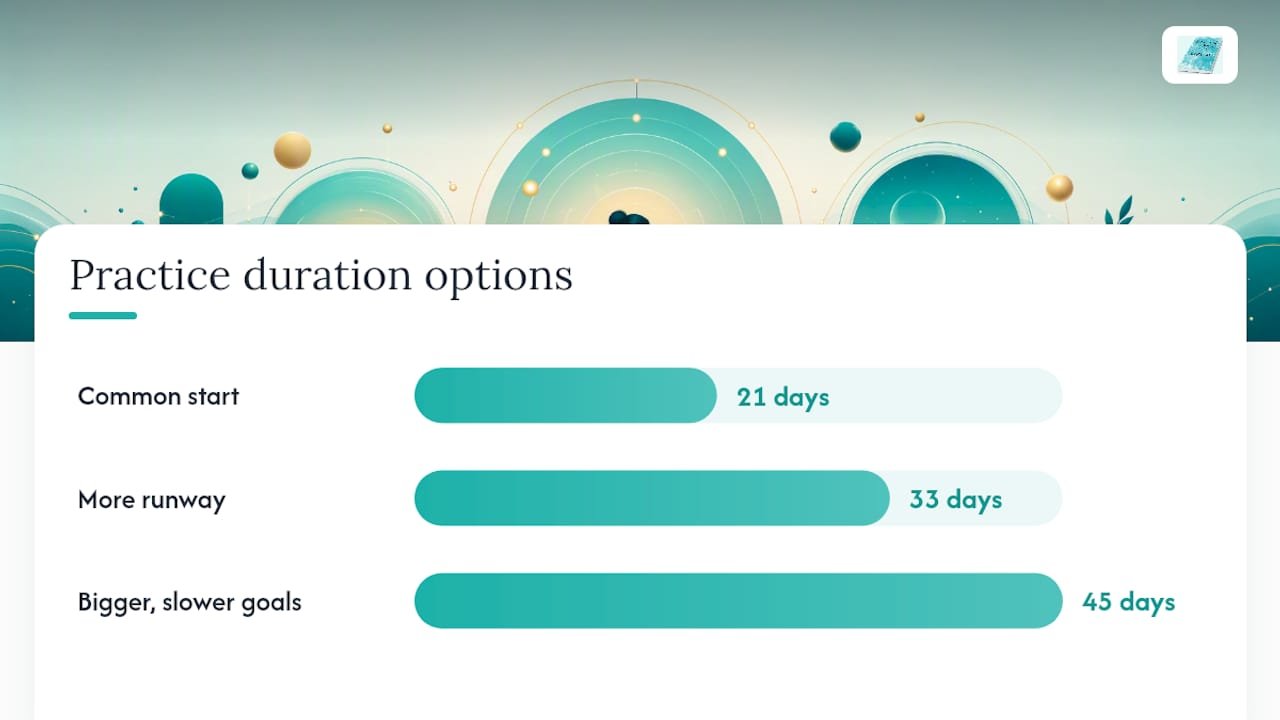
Twenty-one days is the most common starting point, borrowed from the popular (if oversimplified) idea that three weeks builds a habit. Thirty-three days gives a bit more runway for a routine to feel automatic. Forty-five days is usually reserved for bigger, slower-moving goals like a career shift or a long-term financial target.
Internal shifts tend to show up before external ones. Most people report feeling calmer or more confident about the goal somewhere between day 10 and day 20, well before anything changes in the outside world. That’s consistent with how the method is thought to work: repetition primes the brain’s reticular activating system to notice goal-relevant information it would otherwise filter out, while the daily repetition itself reinforces neural pathways tied to the habit.
A rough milestone check:
By day 7: the routine starts feeling automatic instead of effortful.
By day 21: the affirmation feels more believable when you write it.
By day 33: you’re likely noticing small aligned opportunities or decisions.
By day 45: most practitioners can point to at least one concrete shift, internal or external.
Why It Might Feel Like Nothing Is Happening
Three problems account for most stalled 369 practices: a vague affirmation, more than one goal running at once, and skipped days that quietly reset momentum. A fourth, less obvious issue is writing the affirmation without ever acting on it, journaling ten opportunities into existence while ignoring the one that showed up in your inbox.
Run a quick audit if you’re three weeks in with no shift:
- Read your affirmation aloud. If it sounds forced or overblown, rewrite it smaller.
- Check whether you’ve quietly been rotating between two or three goals instead of committing to one.
- Look at your tracker (a simple calendar with checkmarks works fine) for gaps longer than a single missed day.
- Ask whether you’ve taken any small real-world action tied to the goal in the last week.
Phone notes are fine for reminders, but handwriting is worth defending here: pen-on-paper engages motor and memory pathways that typing on a screen skips over, which is part of why so many guides insist on a physical journal for the actual repetitions.
Pro Tip: If day 10 feels dead, don’t wait until the end of the cycle to fix it. Pause, rewrite the affirmation with more specific, believable language, and restart the count from day 1. A clean restart beats limping through weeks of a sentence that never felt true.
Pairing 369 With Visualization and One Daily Action
The journaling alone isn’t the whole practice. Before you write, take 20 to 30 seconds to ground yourself with slow breathing. After each session, close your eyes for another 10 to 30 seconds and picture the affirmation as already true.
- Ground with a few slow breaths before picking up the pen.
- Write your repetitions at a pace where you actually feel the words.
- Visualize the outcome for a few seconds immediately after writing.
- Choose one small, aligned action for the day, replying to that email, applying to that role, and do it before the evening session.
Practitioners who pair the ritual with one aligned action daily tend to report better outcomes than those who journal and stop there. The writing primes your attention. The action is what actually closes the loop. Stack the whole thing into a 10 to 20 minute morning and evening routine and it stops feeling like extra work.
Where the Structure Behind This Practice Comes From
Spiritualmethod builds practical methods toward inner healing of mind, body, and soul, and the 369 routine fits squarely into that focus on structure over vague inspiration. The brand’s downloadable spiritual awakening guide includes journal templates and habit trackers built for exactly this kind of daily practice, so instead of improvising a tracking system, you get a ready-made one. Ritual scripts inside the guide also offer scaffolding for the grounding and gratitude moments that bookend a strong 369 session. Readers can find these templates and trackers directly in the downloadable guide collection.
When 369 Actually Helps and When It Doesn’t
The 369 method works best for clarity, habit-building, and goals of a manageable size, a job search, a confidence shift, a savings target. It’s not a substitute for professional help with urgent medical, legal, or financial situations, and no version of this practice should be treated as one.
What it does well is force you to name one thing clearly and repeat it daily. Surrender the outcome, but pair it with real action. That combination, not the ritual by itself, is where most of the actual movement happens.
— Sean
Ready-Made Templates for Your 369 Practice
Running 369 with a blank notebook works, but it puts the entire burden of structure on you: designing a tracker, writing ritual language, remembering which day you’re on. Spiritualmethod’s downloadable spiritual awakening guide removes that friction with journal templates, forgiving habit trackers, and ritual scripts built specifically for routine-based practices like this one.

The guide is a one-time purchase and is built for readers who want structure without needing to design it themselves. It won’t manifest anything on its own, no download does that, but it gives you the scaffolding to run a full 21, 33, or 45 day cycle without losing steam halfway through. If you’re the kind of person who sticks with a practice better when the tracker is already made and the template is already formatted, this is the shortcut. You can also pair the routine with grounding techniques from a mental wellness partner resource for the breathing work that opens each session. Get the full guide and templates and start your next cycle with the structure already built.
Sources
The how-to steps and duration guidance draw from TheList’s breakdown of the method and Calm’s practical walkthrough. The psychology explanation comes from Verywell Mind’s analysis, and the day-by-day templates reference ManifestationRoutine’s complete guide.
- How to use the 369 method — Calm blog
- Manifest your goals with the 369 method — Verywell Mind
- Manifestationroutine
FAQ
What Is the Correct Way to Do the 369 Method?
Write one present-tense, specific affirmation 3 times in the morning, 6 times at midday, and 9 times in the evening, every day for a set number of days. Handwriting is generally preferred, and the core structure stays the same regardless of which goal you’re working toward.
Does the 369 Method Actually Work?
No controlled research proves the ritual alone changes outside events, but the repetition plausibly works through attention priming and habit formation, the same mechanisms behind most consistency-based practices, according to Verywell Mind. It tends to work best when paired with daily aligned action rather than treated as a standalone fix.
How Long Should You Do the 3, 6, 9 Method?
Most practitioners choose around three to six weeks, with shorter cycles common for smaller goals. Internal shifts like confidence or clarity often show up within the first two to three weeks, while external results tend to take the full cycle or longer.
Can You Do the 369 Method on Your Phone?
Yes, a notes app or reminder app works for tracking sessions, but handwriting is still recommended for the actual repetitions themselves. Pen-on-paper engages memory pathways that typing tends to skip, which is why most guides, including Spiritualmethod’s own downloadable journal templates, are built around a physical notebook format.
What Does the Spiritualmethod Guide Cost?
The Spiritualmethod downloadable spiritual awakening guide is a one-time purchase of $20, with instant digital delivery after checkout. It includes journal templates and trackers you can adapt directly to a 21, 33, or 45 day 369 cycle.